
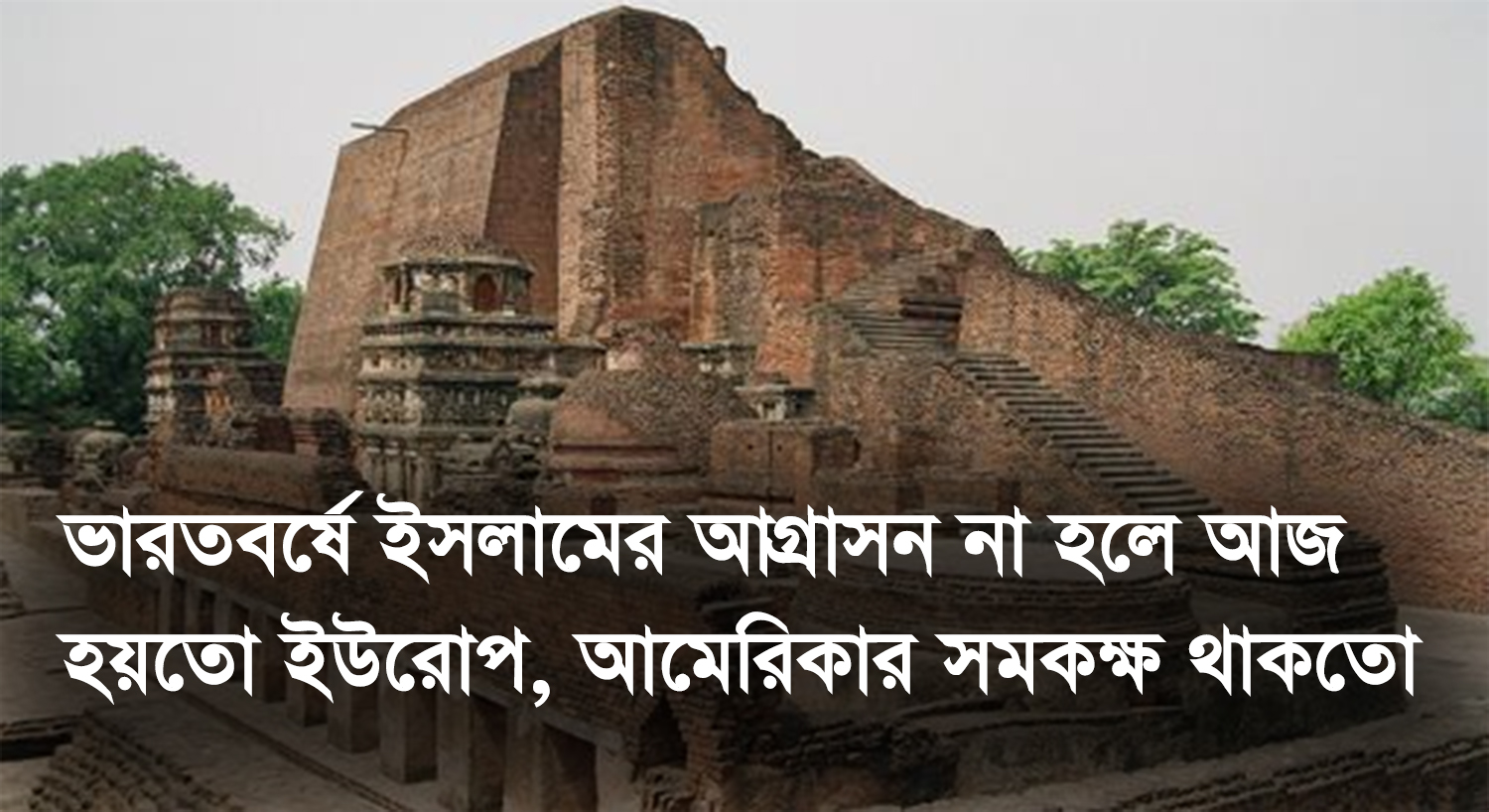
First University in the World
Had Islamic aggression not come to India, the Indian subcontinent might today have been on par with Europe and America
Once, during an India tour, I travelled to Shimla and Manali with a group. I was the only Bangladeshi. Everyone else was from different states of India. Among them were a retired schoolteacher and her husband, a former high-ranking railway official. The first words they uttered when they heard I was from Bangladesh were: “Taslima Nasrin.”
To them, I was less a citizen of neighbouring Bangladesh and more a person from the country of Taslima Nasrin. This is the reality – even if India’s educated, aware people do not know the name of Bangladesh’s prime minister or education minister, they all know about Taslima Nasrin’s achievements. Her solitary struggle for human rights, women’s rights, justice, and freedom of speech, and her combative personality, attract them. For many abroad, Bangladesh now means Taslima Nasrin. Whether you accept it or not – this is the reality.
Another such figure was Atish Dipankar Srigyan. If you go to educated, aware Tibetans, they may not have heard the name of Bangladesh, but at the mention of Atish Dipankar, they will bow their heads in respect.
This great scholar, born in 982 CE in Bikrampur (present-day Munshiganj), was a student and later an acharya (master) at Nalanda and Vikramashila universities. He was proficient in many languages including Sanskrit, Pali, and Tibetan, and he presented the most complex doctrines of Buddhist philosophy in an accessible way. In 1042 CE, at the invitation of the Tibetan king Yeshe Ö, he travelled to Tibet and ushered in a revival of Buddhist knowledge there. Tibetans still honour him today as “Jowo Atisha.”
At that time, many foreigners came to this land of Bengal in search of knowledge. From distant China, Japan, Korea, Thailand, Malaysia, and Indonesia, groups of students would come, stay for years, receive education, and then return to their own countries. The Bengali calendar, Pahela Baishakh — this culture and science spread to various parts of Asia in this way.
The Indian subcontinent: The primordial school of civilization
Many of you may not know that many fundamental concepts of civilization and science originated in this Indian subcontinent. The decimal number system, the concept of zero, algebra, trigonometry – the creators of all these were our ancestors. Aryabhata discovered the rotation of the Earth almost a thousand years before Copernicus. Brahmagupta defined the mathematical use of zero. Charaka and Sushruta wrote medical treatises that are still relevant today.
Taxila: The world’s oldest centre of learning
Many recognize Taxila as the world’s first university. It was located in what is now Pakistan’s Punjab province, only 32 kilometres from Islamabad. Its journey began around 700 BCE. It was not like the modern universities we see today, but for its time it was considered the best in the world – that is what many believe.
There were opportunities to study about 60 subjects here – the Vedas, language, grammar, philosophy, Ayurveda, archery, politics, military science, astrology, mathematics, economics, music, and handicrafts. Students came from Babylon, Arabia, Egypt, China, and Greece. The famous physician Charaka, the political scientist Kautilya (Chanakya), and the grammarian Panini were students or teachers at this very Taxila.
At Taxila, more than 10,000 students and teachers lived together at one time. Poor students covered their educational expenses by doing various jobs. Financial assistance also came from the royal treasury. Sadly, however, there is no evidence of women’s education at this university – a major indication of the limitations of that era.
Nalanda: The world’s first residential university
After Taxila, about 10 more universities were established in the Indian subcontinent — Nalanda, Vikramashila, Vallabhi, Odantapuri, Jagaddala, etc. At that time, there were no universities in Europe. Almost all European universities were founded after 1000 CE.
Among them, the most glorious was Nalanda University – the world’s first fully residential university. It was located in Bihar, 88 kilometres southeast of Patna. Founded in the fifth century under the patronage of the Gupta emperors, it remained the world’s foremost centre of learning for about 700 years until its destruction in 1193.
At one time, Nalanda had about 10,000 students and 2,000 teachers. Students came from Tibet, China, Greece, Persia, and Korea. The Chinese pilgrim Xuanzang studied here for a long time in 635 CE, and from his accounts we get a detailed picture of Nalanda. The university library had three huge buildings — Ratnaranjaka, Ratnodadhi, and Ratnasagara. Hundreds of thousands of manuscripts were preserved there.
Bangla’s illustrious son Atish Dipankar studied at Nalanda and Vikramashila and later became the chief acharya of Vikramashila.
The history of destruction: The arrival of Islam and the fall of Nalanda
In 1193 CE, the Turkic military commander Bakhtiyar Khilji, during his Bengal campaign in the name of Islam, attacked Nalanda and completely destroyed it. Not only Nalanda, but in the same campaign the universities of Vikramashila and Odantapuri were also reduced to ashes. This is a characteristic of Islam: wherever it goes, it destroys the local knowledge, science, culture, and language, and establishes the glory of Islam’s airy superiority.
It is said that after the library of Nalanda was set on fire, the books burned continuously for three months. From this description, one can guess what an immeasurable wealth of knowledge was there. Hundreds of years of manuscripts, research, translations – all turned to ash. The scholars who could not escape were killed. Those who survived fled to Tibet and South India – taking with them whatever they could.
The impact of this destructive act was not confined to India alone. A vast portion of the knowledge that had been built up over centuries and had spread to the corners of Asia was lost forever.
Islamic rule: It held us back far more than it advanced us
From Bakhtiyar Khilji’s attack up to the fall of the Mughal Empire, during nearly 600 years of Muslim rule, what changes occurred in India’s tradition of knowledge? This is a complex and debated question. However, it can be said with certainty that they did very little to advance knowledge and science, just as the forces that rule today in the name of Islam also do very little.
On the one hand, it is a stark truth that in the early phase of the Delhi Sultanate, many Hindu temples, Buddhist monasteries, and centres of learning were destroyed. Patronage for local scholars declined. Traditional institutions of Sanskrit learning were weakened.
On the other hand, some truths are these – in the later Mughal period, especially during the reigns of Akbar, Jahangir, and Shah Jahan, a particular kind of culture developed. Although Akbar himself was illiterate, he was a patron of knowledge, and in his court there were scholars of various religions and schools of thought. Ain-i-Akbari and Akbarnama are invaluable historical documents of that era. Birbal, Tansen, Abul Fazl – they were luminaries in various fields in the Mughal court. He did these things because he was able to free himself somewhat from Islamic doctrines and ideas.
But critics quite rightly ask – was this patronage primarily for royal entertainment and propaganda, or for genuine dissemination of knowledge? Were public-oriented universities like Taxila and Nalanda built during the Mughal era? The answer is – no. Could there have been ten Oxfords in India? The answer is – yes. But they did not do it, because such things do not align with the principles of Islam. In Islam, knowledge means the Qur’an, Hadith, and the afterlife. All other forms of knowledge are secondary in their eyes.
The enormous amount of money spent on building the Taj Mahal – about 32 million rupees in contemporary terms – could have funded the construction of many higher education institutions. During Shah Jahan’s reign, there was a terrible famine in Bengal in which hundreds of thousands of people died – yet the construction of palaces and monuments continued. This is a real and bitter point of criticism of the Islamic system of governance of that time.
During Aurangzeb’s reign (1658–1707), the situation became even worse. He banned music, demolished Hindu temples, and reimposed the jizya tax. Many scholars and artists were forced to leave the court.
There is, of course, some self-criticism
Is it entirely true to blame only external invasions for the decline of India’s intellectual tradition? Historians identify some other reasons as well –
The chains of the caste system: At Taxila and Nalanda, women could not study, Shudras could not study. Knowledge was the exclusive property of the upper castes. This inequality itself was a major obstacle to the spread of knowledge.
Political fragmentation: The subcontinent was never a unified entity. Wars between different kingdoms were constant. Some historians believe that even before Bakhtiyar Khilji, Buddhist monasteries had been attacked by Hindu kings.
Technological stagnation: In the Middle Ages, when Europe was moving towards the Industrial Revolution, India remained stuck in an agrarian feudal structure.
These inequalities existed in all parts of the world at that time, but who can say that a Renaissance could not have occurred in India before Europe? If the natural flow of knowledge of that time had been allowed to continue, such a Renaissance would have been inevitable. India might then have led the world in knowledge – what is wrong in imagining that?
There is no way to deny that Bakhtiyar Khilji’s attack and the power-centric policies of subsequent regimes created a huge wound in India’s intellectual tradition. Hundreds of thousands of manuscripts were burned, thousands of scholars were killed or exiled, many lineages of knowledge were severed forever – it is impossible to measure this loss.
The rebirth of Nalanda
In 2006, Singapore, China, Japan, and several other countries decided that Nalanda would be rebuilt. In 2010, the Nalanda University Act was passed in the Indian Parliament. In 2014, the new Nalanda University began its activities. This is not just the story of the re-establishment of a university – it is a symbol of the recovery of a civilization’s memory. But what could have been can no longer be. The institution that could have led the entire world in knowledge and science is now just one among several thousand institutions. Singapore, China, and Japan know how much Nalanda once contributed to the knowledge and prosperity of their regions. That is why they have taken the initiative again today, perhaps to repay some of that debt.
What would India be like today?
History never moves in a straight line. The rise of India’s knowledge civilization was one of humanity’s greatest achievements. Its decline was the combined result of many factors – external invasions, internal social inequality, political fragmentation, and the shortsightedness of Muslim rulers.
But the light of that knowledge did not go out completely. In Tibet, China, Japan, and Southeast Asia – the seeds of that knowledge had been scattered. Today, our responsibility is to know that history correctly, to evaluate it properly – and to draw inspiration from that lost heritage to once again become a centre of learning. Had imperialist Islamic aggression not come to India, perhaps India’s position today would have been equal to that of Europe or America. Because knowledge and science cannot run parallel with Islam; they have never done so anywhere, and they still do not today.
Disclaimer: This is not a historical or academic article. There may be some historical or factual errors.
Related Posts

Why does Allah show such preference for women with large breasts and large buttocks? Do men feel the same way? Does this give women any advantage?
If you leave Prophet Muhammad in Pattaya’s Walking Street and Beach Road after evening, inRead More
নারীর বড় বক্ষ ও নিতম্বের প্রতি আল্লাহর এতো পক্ষপাত কেন? পুরুষেরও কি তাই? এটা কি নারীকে সুবিধা দেয়?
আপনারা যদি পাতায়ার ওয়াকিং স্ট্রীটে ও বীচ রোডে সন্ধ্যার পর আলো আঁধারিতে নবী মুহাম্মদকে ছেড়েRead More

Do women like the color pink? What is the psychology behind it?
Last winter my friend Lamia went to buy a birthday present for her niece. TheRead More
Comments are Closed