
Hindus are Under Attack in Bangladesh
In Bangladesh, the very meaning of the “blasphemy” law is to find a new pretext for persecuting minorities
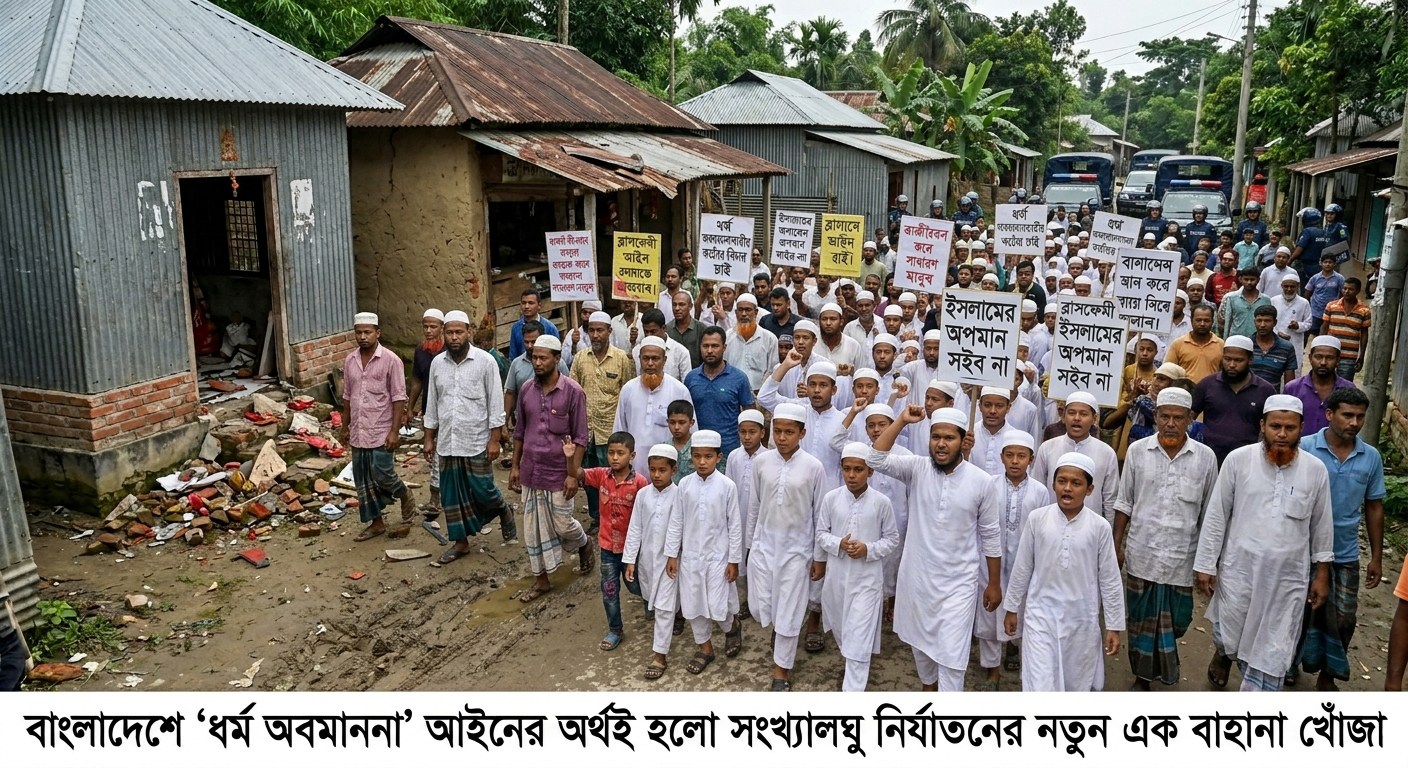
The attack on the house, shop, and temple of Deepto Roy in Tahirpur, Sunamganj is nothing new. It is part of a long, repetitive, and almost predictable pattern—where a Facebook post, whether true or false, is transformed into mob lynching, vandalism of homes, and arson in temples. And this entire process is legitimized under the cover of a notion called “blasphemy against religion” (“ধর্ম অবমাননা”)—which is fundamentally problematic according to modern democratic and human rights standards. But the so‑called Tawhidi masses, the self‑proclaimed servants of Islam in Bangladesh, do not care in the least about any international convention, human rights principles, or the idea of freedom of expression. The most frightening aspect is that in the front row of the frenzied Tawhidi mob we see little madrasa students! At this very age, the poison of Islam is being poured into their heads and the process of turning them into fanatics has already begun.
The core foundation of modern liberal democracy stands on the fusion of citizens’ freedom of expression and freedom of religion, which clearly declares that no ideology, belief, or doctrine—whether religious or political—is above criticism. In a free and progressive society, people have the inalienable right to question any established school of thought or religion, to analyze it rationally, and to strongly criticize the mistakes and faults of its proponents. This right is not confined merely to mild disagreement; it also includes, when necessary, the freedom to express one’s dissent or anger in strong language, and even to use harsh or insulting words as part of that freedom. When a society or state system legally and socially recognizes this right of citizens to raise questions without fear and to express independent opinions even on sensitive issues like religion and politics, only then is the practice of genuine liberal democracy ensured. Silencing the public by declaring any doctrine inviolable or sacred is fundamentally contrary to the spirit of democracy.
In 2011, the United Nations Human Rights Council withdrew its resolution on “defamation of religions,” because international human rights experts agreed that the law protects people, not beliefs. When laws are enacted in the name of protecting religious feelings, they end up criminalizing freedom of expression and become tools for suppressing minority voices. The function of law is to protect people like Deepto Roy, Utshab Mondal, Jhumon Das, Deepu Chandra Das—in other words, human beings. When the laws and law‑enforcement agencies of a country take on the responsibility of protecting the religious beliefs of the majority instead of protecting its citizens, then it must be understood that the laws and system of that country are still trapped in a circle of barbarism.
In the context of Bangladesh, this concern is not imaginary—it is real and repeatedly proven.
In Bangladesh, the Digital Security Act (or its successor, the Cyber Security Act) and Section 295(A) of the Penal Code have effectively turned into a reliable weapon against minority communities. The pattern is as follows:
First, the accusation: a Facebook post—often in the form of a screenshot, often taken out of context, sometimes from a fake or hacked account—spreads.
Second, the judgment of the Tawhidi masses: without any verification, the “enraged Tawhidi masses” launch attacks. Homes are destroyed, temples are burned, people die, people flee.
Third, the role of the police: the police take the victim into custody “for security”—that is, instead of the accused, the person fleeing to save themselves from the attackers is arrested.
Fourth, impunity: generally, no effective action is taken against the attackers. No such precedent has been seen so far.
This cycle is so well‑known that there is no way to call it an “isolated incident” anymore.
The ironic thing is that many Islamic preachers themselves say things about other religions—or even about Islam—that, if said by a follower of the Hindu religion about Islam, would lead to a completely different outcome.
This double standard is not just a matter of personal bias—it is a social problem. When the “blasphemy” law is effectively applied only against minorities, then that law is no longer an instrument of justice—it becomes an institutional form of discrimination.
If in Cumilla it is possible to spread violence based on a false allegation of placing a Qur’an in a Durga Puja pavilion, then the question arises—is this “blasphemy” really a reaction against the insult of religion, or is it a convenient pretext for pre‑planned violence? Just think for a moment: if, instead of Gada Iqbal, someone named Subrata Mondal had placed the Qur’an at the feet of Hanuman in Cumilla, would the Tawhidi masses have spared him alive on this earth? How much greater would the rampage have been, how many more homes would have burned in the fire—try to imagine it once. What happened to Gada Iqbal? Because Iqbal is a Muslim, a member of the majority. It is even possible that some conspiratorial Islamists used Iqbal with the intention of exterminating Hindus.
The Constitution of Bangladesh speaks of secularism and equal rights for all citizens. But in practice, the state repeatedly makes two mistakes:
First mistake—failure to prevent: despite having intelligence information before the violence, at the stage when tensions are being incited, the state remains inactive.
Second mistake—bowing to the pressure of the Tawhidi masses: in the name of “maintaining law and order,” what the police essentially do is arrest the accused or the primary victim to appease the anger of the masses—even before any investigation. This sends the message that whenever the Tawhidi masses take to the streets, the state becomes theirs.
These two failures together create an environment in which minorities know—they live in a land where there is no fixed time or pretext for danger; they can be attacked as “insulters of Islam” even before they click the post button on Facebook.
Is Islam really that fragile? This question is not mere rhetoric. A religion that has sustained the faith of hundreds of millions of people around the world for more than fourteen hundred years—can that religion truly be “insulted” by a young man’s Facebook post? If not, then what is the source of this rage? Islamic preachers and Islamists constantly mock, ridicule, criticize, and threaten the beliefs of other religions at riverbanks, in fields, on streets, and on social media—how do they maintain such patience then? Are their religious beliefs and religions founded on a stronger base than Islam? Judging by the behavior of the Islamists, that is what it seems—this religion of two billion people collapses in a shriek at a trivial Facebook post by a young man! Even when one quotes directly from Islamic books, the Qur’an, Hadith, Sira, and Tafsir, Islamists now bring accusations of blasphemy! What an astonishing matter!
The answer probably lies in the fact that the claim of “hurt religious feelings” is often not a sincere spiritual pain—it is a method of demonstrating political power. It is a strategy to instill fear in minorities and pressure them into voluntarily withdrawing themselves. Even if Islamists lack knowledge, intellect, education, technology, skills, and competence, they are far greater in number, and they have millions of frenzied blind followers—by attacking minorities they display the power of that numerical strength. Since the state stands with them, they continue to stage such displays of power one after another.
In Bangladesh, the notion of “blasphemy” has turned into an unacceptable weapon for a civilized society. To stand against it does not mean to stand against religion—it means to assert that:
The law must be equal for everyone. No person’s physical safety can depend on a Facebook post. The state cannot administer justice under the pressure of the mob. Granting legal protection to beliefs against criticism is contrary to human rights.
The temple of Deepto Roy has been demolished, and it is unknown where the rampage of the Tawhidi masses will finally stop. But this rampage is also destroying something else—the promise of Bangladesh, where people of all religions would be able to live as equal citizens. What India is doing or not doing for the safety or rights of its minorities is irrelevant here. What is visible is that as a state, Bangladesh is repeatedly proving its failure, one after another.
Related Posts

Actresses Shabana, Moushumi, Popy – Religious Sentiment and the Politics of the Public Sphere
In the history of Bangladeshi cinema, names like Shabana, Moushumi and Popy mark important chapters.Read More
নায়িকা শাবানা, মৌসুমী, পপি – ধর্মানুভূতি এবং জনপরিসরের রাজনীতি
বাংলাদেশের চলচ্চিত্র ইতিহাসে শাবানা, মৌসুমী কিংবা পপির মতো নাম গুরুত্বপূর্ণ অধ্যায়। তারা আশি, নব্বই ওRead More
বাংলাদেশে “ধর্ম অবমাননা” আইনের অর্থই হলো সংখ্যালঘু নির্যাতনের নতুন এক বাহানা খোঁজা
সুনামগঞ্জের তাহিরপুরে দীপ্ত রায়ের বাড়ি, দোকান ও মন্দিরে হামলার ঘটনা নতুন কিছু নয়। এটি একটিRead More
Comments are Closed