
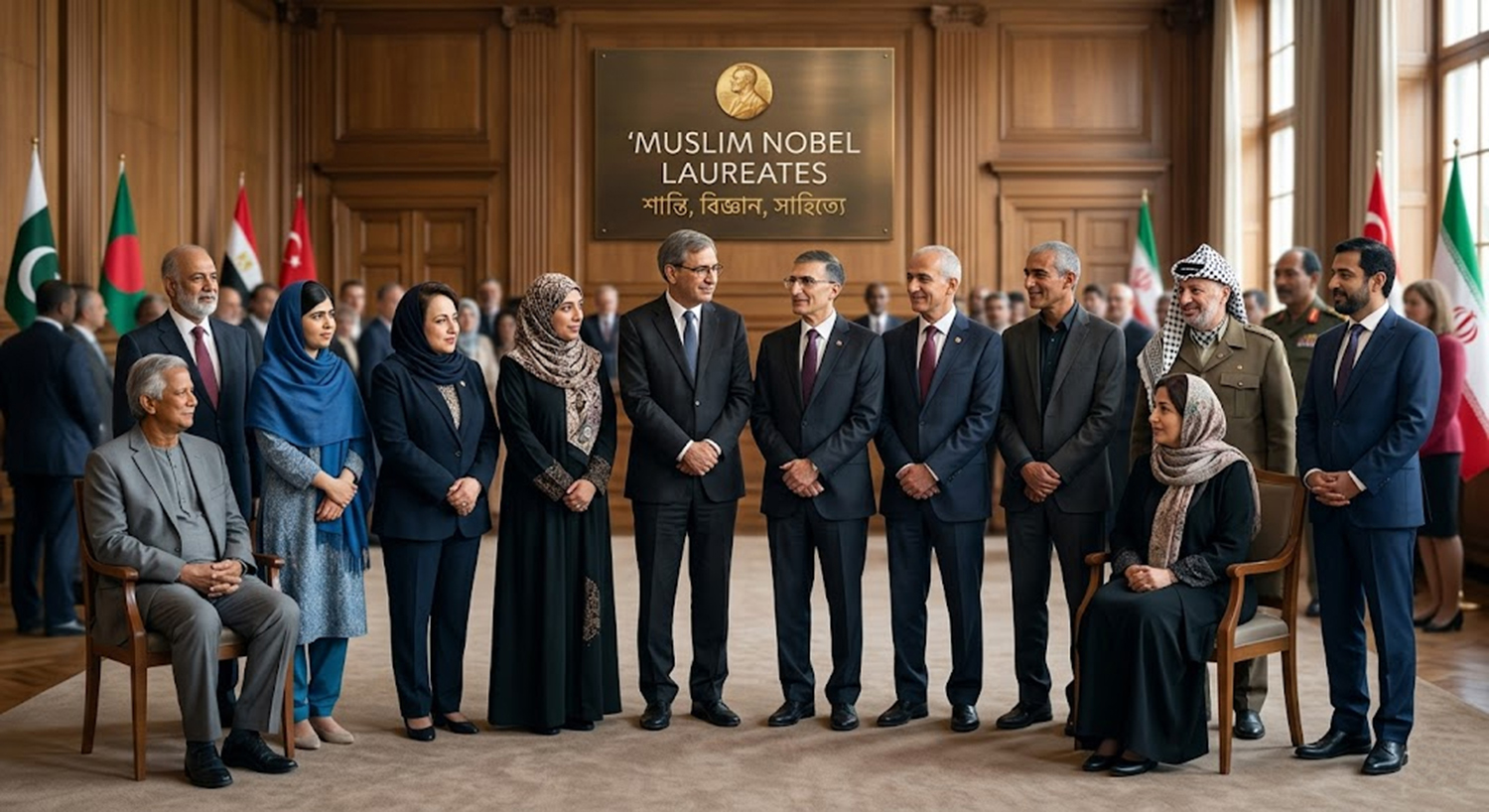
The Conflict Between Islam and Science
It seems that being born a scientist or social worker in Muslim‑majority countries is treated almost like a sin
Three people born on Pakistani soil have received the Nobel Prize so far. Professor Dr. Abdus Salam won the Nobel Prize in Physics in 1979. But because of his Qadiani (Ahmadi) identity, ordinary Pakistanis feel shame rather than pride. A few years ago, I saw in the Dawn newspaper that villagers had broken the epitaph on Dr. Salam’s grave. After his death in 1996, he was buried in his own village according to his last wish. His epitaph read “First Muslim Nobel Laureate” — on his death anniversary, the villagers uprooted it. Later, by court order, it was restored — but with one word removed: “First ______ Nobel Laureate.”
Long before receiving the Nobel Prize in 1979, he had to leave his country due to political and social hostility, mainly because of threats to his life for being an Ahmadi. Even after receiving the prize, nothing improved. Until his death, he could never return to Pakistan.
In 1996, Dr. Salam visited Bangladesh once. Ironically, shortly after his visit, fundamentalists created chaos at Baitul Mukarram demanding that Ahmadis be declared non‑Muslim.
In 2014, at just 17 years old, Malala Yousafzai became the youngest Nobel laureate in history by winning the Nobel Peace Prize. She received the award jointly with India’s Kailash Satyarthi for her work on children’s right to education. Because of severe security threats from extremist and terrorist groups, she cannot stay in Pakistan freely or for long periods even if she wants to.
Additionally, biochemist Dr. Har Gobind Khorana, born on what is now Pakistani soil, won the Nobel Prize in Physiology or Medicine in 1968. Although he was an American citizen, he was born in undivided Punjab, now part of Pakistan. Yet he is never included in Pakistan’s list of pride — again, because of religious identity.
So far, 15 Muslims have received the Nobel Prize. Sadly, 10 of them had to flee their homelands due to death threats from Islamic law enforcers or mobs. Islamists always place religious identity and Islamic faith above everything else. In these countries, being born a scientist or social worker itself seems like a crime.
Science or social work does not recognize religion, race, or geographic boundaries. No religious scripture is written inside a laboratory or telescope — only the pursuit of truth exists there. We do not label Newton, Galileo, Einstein, or Hawking as Christian/Jewish/Atheist scientists. But under the banner of the “Islamic Golden Age,” many medieval scholars are repeatedly labeled as “Muslim scientists” to claim religious ownership.
Today, many believers, religious speakers, or writers proudly cite names like Ibn Sina, Al‑Razi, or Ibn Rushd as “Muslim scientists.” But history shows that these individuals were despised by the hardline Islamic religious authorities of their time for their scientific and philosophical ideas. Influential theologians like Imam Ghazali labeled many of their philosophies and scientific thoughts as kufr (against Islam). And they did not stop at calling them heretics — they insulted them, humiliated them, beat them until they bled, confined them as “mad,” exiled them, imprisoned them, and even killed some. Imam Ghazali’s Tahafut al‑Falasifah (The Incoherence of the Philosophers) is a major example of this conflict.
The same Islam that once placed thorns in their path now proudly claims them as “Muslim scientists.” What hypocrisy of Islam!
Related Posts
Everything is a Gift from Allah …
The day of bride-seeing in a Bengali household is like an unwritten stage play—where everyRead More
সবই আল্লাপাকের দান …
বাঙালি ঘরে কনে দেখার দিনটিও যেন এক অলিখিত নাট্যমঞ্চ – যেখানে প্রতিটি সংলাপ, প্রতিটি অঙ্গভঙ্গিRead More

When a Loved One Suddenly Feels Like a Stranger: What Causes This Neglect?
Siam met Liza in the second year of university. For the first six months, SiamRead More
Comments are Closed