
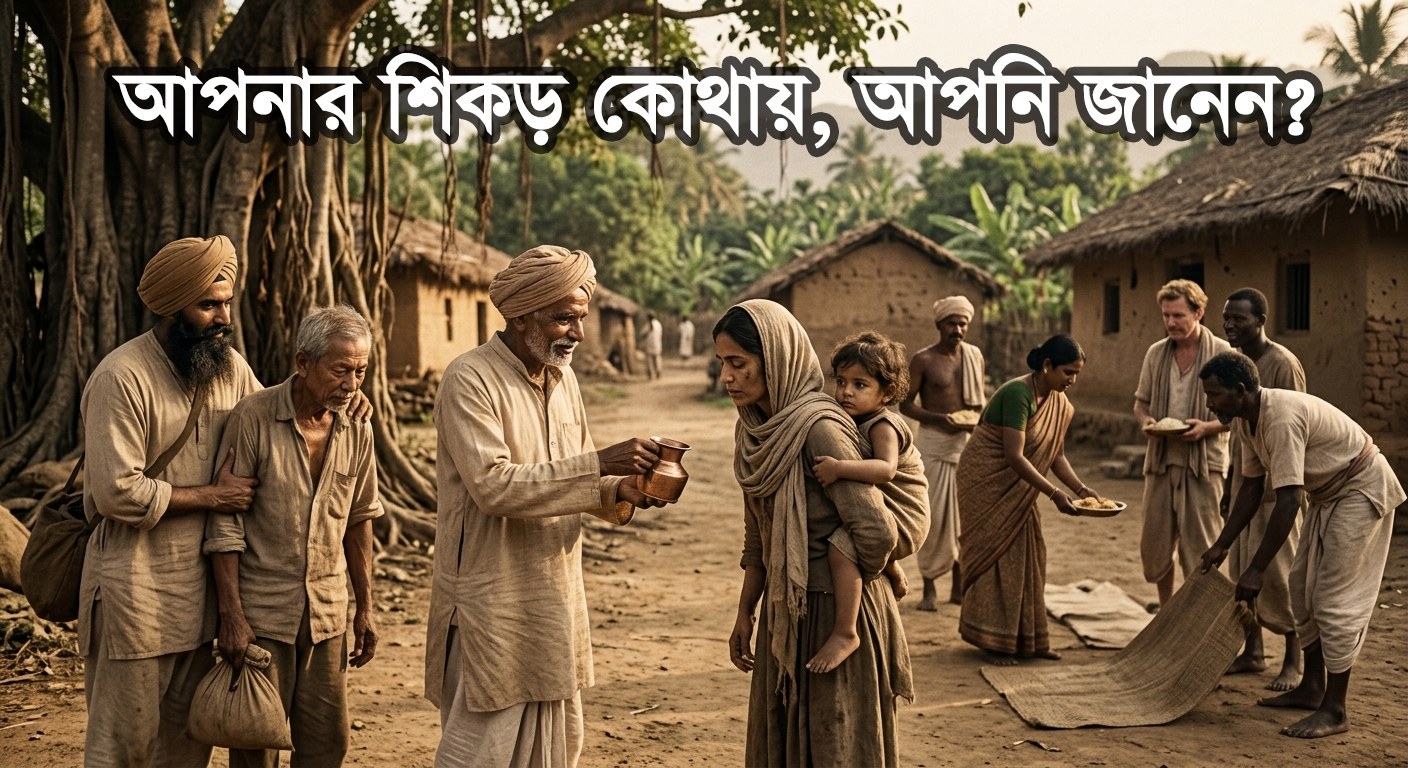
The Root of Indians
As a person of the Indian subcontinent, how much do you really know about your roots?
If you walk along the path of two thousand years of history, you will not only feel proud of your genetic heritage, but you will also witness the unfolding of a remarkable truth — the land that we today recognize as a symbol of poverty and underdevelopment, the Indian subcontinent, was once the cradle of one of the world’s most prosperous, knowledgeable, and generous civilizations. A review of thousands of years of history reveals that famine had no existence in India. Yet, following the periods of colonial domination, millions of people in this subcontinent became among the most neglected, deprived, and impoverished populations in the world. Behind this decline lies centuries of plunder by external forces, colonial exploitation, and artificial divisions created in the name of religion. Let us take a walk along the path of history. It should be noted, my descriptions may not be 100% accurate, and I welcome corrections.
1. Golden India — The Age of Prosperity
1.1 India’s Contribution to the Global Economy
British economic historian Angus Maddison revealed an astonishing fact in his groundbreaking research. According to his findings, from the first century CE to 1700, for nearly two thousand years, India contributed around 25–30 percent to global GDP. At the time of the establishment of the East India Company in 1600, Britain’s share of global GDP was only 1.8 percent, whereas India’s was 22.5 percent. During the reign of Mughal Emperor Aurangzeb, annual revenue from taxes alone was about 100 million pounds. India was then the world’s leading manufacturing nation — textiles, metallurgy, mineral resources, agriculture — in every field it led the world.
This prosperity was rooted in India’s agrarian, peace-loving society. The people of India never harbored imperial ambitions. They did not seek to conquer other lands; rather, they achieved prosperity through production, industry, and trade within their own land. Since ancient times, Indian merchants traded with Arabia, Southeast Asia, China, and Europe, exchanging goods and ideas.
1.2 No Famine for Thousands of Years
Historical evidence from pre-colonial India indicates that there were no major famines for thousands of years. This was due to its diverse agricultural systems, local storage practices, and strong traditions of community-based support. Different regions cultivated different crops, so crop failure in one region could be compensated by supplies from another. This stability was a testament to the inherent strength of Indian society.
2. Beacon of Knowledge — Taxila and Nalanda
2.1 Taxila — The World’s First University
Established around 700 BCE in the Gandhara kingdom (present-day Punjab province of Pakistan), Taxila is recognized as the world’s first organized higher education institution. It was located at the crossroads of three major trade routes — connecting eastern India, West Asia, and Kashmir. Thus, Taxila was not just an academic institution but an extraordinary hub of civilization.
It offered education in 68 subjects — including the Vedas, grammar, philosophy, astronomy, medicine, surgery, politics, archery, music, and commerce. The minimum age for admission was 16. Students came from across the world — Arabia, Persia, Greece, and Babylonia. Chanakya, Chandragupta Maurya, and Jivaka (Buddha’s physician) were among its students. In 1980, UNESCO recognized Taxila as a World Heritage Site.
“Taxila was a unique center of learning in the ancient world, where subjects ranging from the Vedas and scriptures to medicine and politics were taught. Students came from distant lands like Arabia, Persia, and Greece in search of knowledge.” — Teachers Institute, Ancient Indian Universities, 2026
2.2 Nalanda — The World’s First Residential University
Established in the 5th century CE in Nalanda (present-day Bihar, India), Nalanda Mahavihara was the world’s first fully residential university. From 427 to 1197 CE, for nearly 770 years, it stood as one of the greatest centers of knowledge in the world. It accommodated around 10,000 students and 2,000 teachers at a time. Scholars from China, Korea, Japan, Indonesia, Persia, and Turkey came here.
Subjects taught at Nalanda included Buddhist philosophy, Vedanta, logic, grammar, medicine, mathematics, astronomy, and the arts. The famous Chinese traveler Xuanzang studied here and left detailed accounts of the institution. Nalanda’s library housed hundreds of thousands of manuscripts in three grand buildings known as ‘Ratnasagara,’ ‘Ratnadhadhi,’ and ‘Ratnaranjaka.’
These two world-class institutions demonstrate that India was not only economically advanced but also a global leader in knowledge, science, and education. Europe’s first university, Bologna, was established in 1088 — nearly two thousand years after Taxila.
3. Land of Generosity — India, the Giver of Compassion
A defining characteristic of the people of the Indian subcontinent has been their generosity and compassion. Whenever people were persecuted anywhere in the world for religious, political, or social reasons, India opened its arms to them.
After the fall of Jerusalem in the first century, persecuted Jews began seeking refuge in India. From at least the fourth century, and possibly earlier, persecuted Christians arrived — particularly in Kerala, where the roots of Saint Thomas Christianity remain strong to this day.
In the mid-7th century (around 641 CE), Arab Muslim forces defeated the Sassanian Empire of Persia, leading to the spread of Islam. Under the Umayyad Caliphate, repression against local Parsis (Zoroastrians) intensified. The jizya tax was imposed, religious sites were destroyed, and social and economic pressures were applied to force conversion to Islam. In the early 8th century, facing such persecution, a large group of Parsis crossed the Persian Gulf and sought refuge in Gujarat (in a place called Sanjan). A local Hindu king, known as Jadi Rana, generously granted them asylum. These refugees later became known as the Parsi community. From Jamsetji Tata to Ratan Tata, many prominent figures are part of this legacy.
Similarly, Armenians, Arab Muslim traders, and the persecuted Baha’i community of the 19th century all found safe haven in India. Even during the time of the Battle of Plassey, merchants and professionals from various European nations settled in the Ganges basin. This enduring culture of openness enriched Indian civilization by embracing diverse peoples, languages, and traditions.
From ancient times, Indian traders, migrants, and scholars traveled to China, Indonesia, Malaysia, Cambodia, Vietnam, and Thailand. Their influence is still visible today in language, literature, and architecture. For example, many of these countries celebrate New Year around the same time as Pohela Boishakh. Bali in Indonesia and Angkor Wat in Cambodia stand as enduring symbols of Indian cultural influence. This phenomenon is known as “Greater India” or the “Indianization” of Southeast Asia. Thailand’s national epic ‘Ramakien’ is based on the Indian Ramayana, and its former capital Ayutthaya derives from the word Ayodhya. Even Thai kings bear the title ‘Rama.’
Without military conquest or forced expansion, India extended its influence through trade, religion (Hinduism and Buddhism), and culture. This soft power remains evident even after a thousand years.
Bengali scholar Atish Dipankar remains an eternal “light of Asia” in Tibetan history. About a thousand years ago, he brought reform and enlightenment to Tibet, leaving a legacy that endures to this day.
4. Centuries of Plunder — The Collapse of a Civilization
4.1 Early Blows from Foreign Invaders
India’s prosperity and peaceful nature made it a recurring target for foreign plunderers. In the 12th century, Bakhtiyar Khilji’s invasion caused immense damage to Nalanda, destroying its libraries and institutions. Historians state that the fires burned for months due to the vastness of the manuscripts.
After Nader Shah’s invasion, it was said that so much wealth was looted from India that Persia could waive taxes for three years. During the Mughal period, it is also claimed that the construction of the Taj Mahal led to famine due to heavy taxation.
4.2 East India Company and British Colonial Exploitation
The establishment of the East India Company in 1600 marked the beginning of one of history’s most systematic economic exploitations. After the Battle of Plassey, nearly a quarter of British Parliament members had shares in the Company, indicating a joint interest in the exploitation of India.
British rule began amid the Great Bengal Famine of 1769–70, which killed around 10 million people. Throughout British rule, recurring famines devastated the population. The Bengal Famine of 1943 alone killed over 3 million people. Altogether, historians estimate that over 60 million people died in famines during British rule.
“In the early 18th century, India contributed 23% of the world economy, equal to all of Europe. When the British left, it had fallen to just 3%. The reason is simple: India was governed for Britain’s benefit.” — Shashi Tharoor, Inglorious Empire
Economist Utsa Patnaik estimates that between 1765 and 1938, Britain extracted approximately $45 trillion (in today’s value) from India. India’s share in global exports fell from 27% to just 2%. Dadabhai Naoroji described this ‘Drain of Wealth’ as the primary cause of India’s poverty.
Wealth looted from Bengal fueled Britain’s Industrial Revolution, while India’s cottage industries were deliberately destroyed. British goods were manufactured using Indian raw materials and then sold back to India — a cycle of exploitation.
5. Independence and Democracy — The End of Famine
Economist Amartya Sen showed that after independence in 1947, India has not experienced famine. He argued that democratic accountability and a free press are the most effective safeguards against famine.
6. Division in the Name of Religion — A Lost Opportunity
6.1 Partition and Its Consequences
The partition of India in 1947 was one of history’s greatest human tragedies. Within weeks, Cyril Radcliffe divided Punjab and Bengal based on religion. Around 15 million people became refugees, and between 300,000 to 1 million people were killed.
Communities that had lived together for centuries were suddenly separated along religious lines, reflecting the peak of the British “divide and rule” policy.
6.2 Long-term Cost of Religious Division
India, Bangladesh, and Pakistan share the same historical roots. Yet religious division has hindered collective progress. SAARC, founded in 1985, has been largely ineffective due to regional tensions.
If united, this region with over 1.7 billion people could have become one of Asia’s strongest economic blocs. Yet its global income share remains disproportionately low.
Religious politics continues to undermine unity and development, turning historically peaceful communities into adversaries.
7. Lessons from History and the Path Forward
A civilization that once led the world in knowledge and trade is now among the poorest regions. This decline is not fate — it is the result of human-made history.
Colonial exploitation and internal divisions shattered economic strength. Yet hope remains. As Amartya Sen demonstrated, democracy can prevent crises.
The people of this region still carry the legacy of Taxila and Nalanda. By overcoming division and embracing shared heritage, they can rebuild that lost glory.
References & Bibliography
1. Angus Maddison, Contours of the World Economy 1–2030 AD — OECD, 2007
2. Shashi Tharoor, Inglorious Empire: What the British Did to India — Penguin, 2017
3. Utsa Patnaik, Drain of Wealth estimate — Columbia University Press, 2018
4. Dadabhai Naoroji, Poverty and Un-British Rule in India — 1901
5. Amartya Sen, Development as Freedom — Oxford University Press, 1999
6. Teachers Institute, Ancient Indian Universities — 2026
7. UNESCO World Heritage — Taxila (1980), Nalanda (2016)
8. Wikipedia — Economic history of India
9. Imperial War Museums — Partition of India
10. Shashi Tharoor, An Era of Darkness — 2016
Related Posts
বিরতি
১ উলিপুর ডাকঘরের টিনের চালে ভোরের রোদ পড়লে জায়গাটা একটু একটু করে জেগে ওঠে। বারান্দারRead More

Jinnah was a thoroughly secular atheist, yet by playing the religious card he divided the country!
The first killing in India over writing and accusations of hurting religious sentiments took placeRead More
জিন্নাহ ছিলেন আপদমস্তক একজন সেকুল্যার নাস্তিক, অথচ ধর্মীয় কার্ড খেলে তিনি দেশ ভাগ করেন!
ভারতবর্ষে লেখালিখির কারনে ও ধর্মীয় অনুভূতিতে আঘাত দেয়ার অভিযোগে প্রথম কোন হত্যাকান্ড ঘটে কলকাতায়, ১৯২৪Read More
Comments are Closed