
Islam Poses a Threat to Children
Child marriage, sexual acts, and intercourse with young girls in Islamic law: a grave crime from the perspective of science, modern law, and humanity
Islam is often promoted as a “religion of peace, beauty, and science.” But many of its fundamental rulings and fatwas stand in deep conflict with modern science, human rights, and law—contradicting those claims of peace, beauty, and scientific harmony. Among the most controversial and condemned issues is the marriage of young girls and the permission for sexual acts with them. This is not a “cultural” or “historical” matter—it is directly part of Quran–Hadith–based Islamic jurisprudence, agreed upon by prominent scholars of both Sunni and Shia traditions. The marriage of Aisha to Prophet Muhammad at age 6 and consummation at age 9 is used as a clear example, as mentioned in Sahih Bukhari (Hadith 5134).
This article analyzes the issue strictly from a critical perspective, avoiding religious sympathy or “respect.” The discussion focuses especially on Ayatollah Khomeini’s fatwa, examining—
- How Islamic rulings conflict with modern law,
- How severely it harms the physical and mental health of young girls,
- And when a female body becomes ready for sexual relations.
Islamic Sources and Khomeini’s Fatwa: Turning a Child into a Sexual Object
Islamic jurisprudence permits the marriage of young girls. According to Sahih Bukhari, Aisha was married at age 6 and the marriage was consummated at age 9. Many scholars present this example as “Sunnah.”
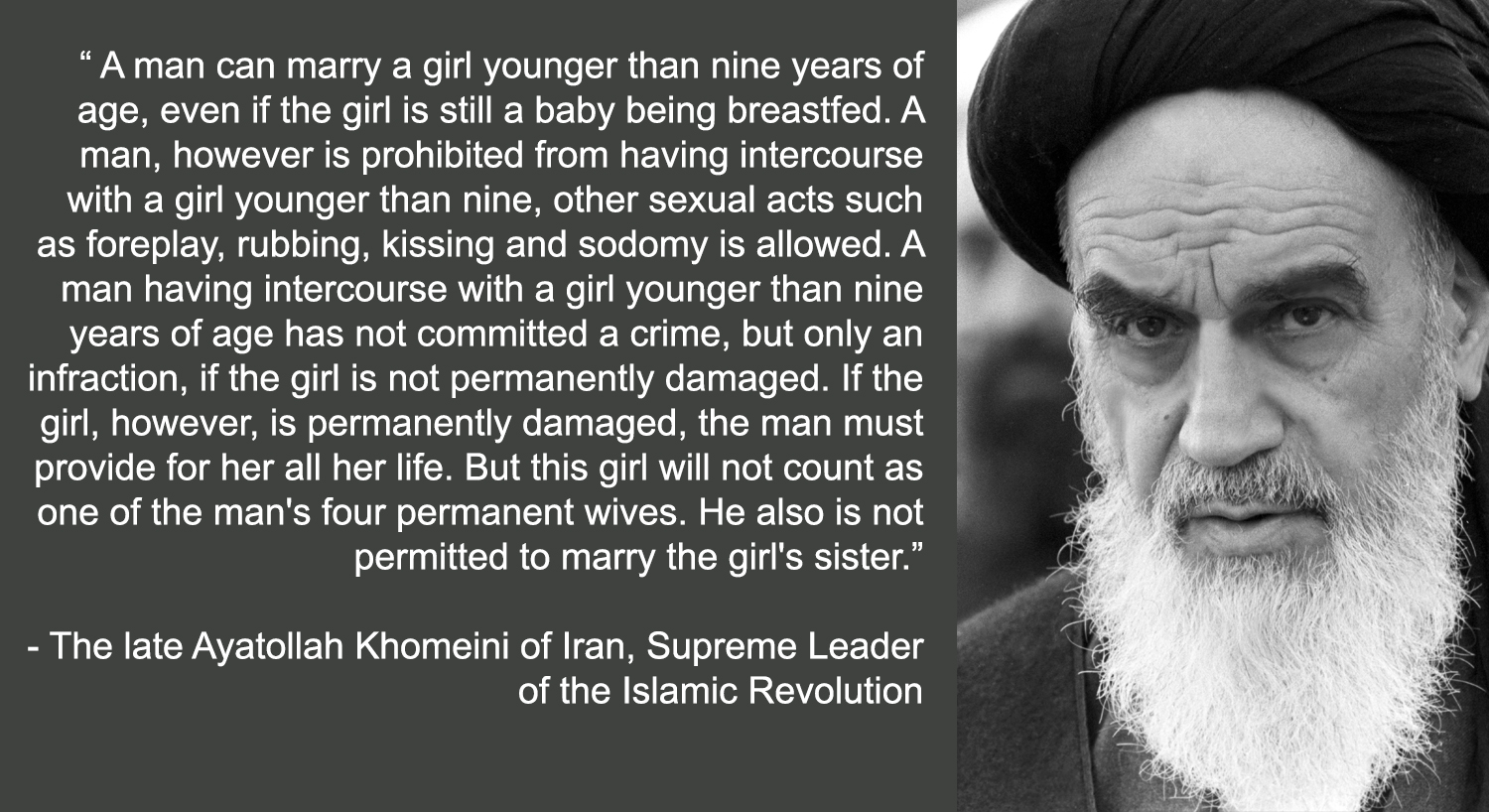
Ayatollah Ruhollah Khomeini, one of the foremost leaders of the Shia tradition and the central figure of Iran’s so‑called Islamic Revolution, issued a clear fatwa in Tahrir al‑Wasila (Vol. 2, Kitab al‑Nikah, Mas’ala 12):
A man can marry a girl younger than nine years of age, even if the girl is still a baby being breastfed. A man, however is prohibited from having intercourse with a girl younger than nine, other sexual acts such as foreplay, rubbing, kissing and sodomy is allowed. A man having intercourse with a girl younger than nine years of age has not committed a crime, but only an infraction, if the girl is not permanently damaged. If the girl, however, is permanently damaged, the man must provide for her all her life. But this girl will not count as one of the man’s four permanent wives. He also is not permitted to marry the girl’s sister.
This fatwa is not a personal opinion. It is part of mainstream Islamic law, based on certain Quranic verses (such as Surah At‑Talaq 65:4 and Surah Al‑Ahzab 33:49) and Hadith interpretations. The core logic is: God’s rulings are unchangeable. Declaring intercourse and other sexual acts “halal” despite the child’s body being undeveloped turns the child into a sexual object. The absence of punishment “if no permanent harm occurs” and mere “maintenance” as a consequence completely denies the child’s basic rights.
Direct Conflict with Modern Law and International Human Rights
Modern law declares these Islamic rulings and the fatwa based on them entirely unacceptable. The United Nations’ Convention on the Rights of the Child (CRC, 1989), Convention on the Elimination of Discrimination Against Women (CEDAW, 1979), and the Consent to Marriage Convention (1962) clearly state: the minimum age for marriage and sexual relations is 18. A child (under 18) cannot give “consent”—therefore any sexual act is considered child sexual abuse.
In many countries the age of consent may be slightly lower (16–18). Child marriage is prohibited or voidable. Khomeini’s fatwa violates these principles entirely. In Iran, influenced by this ruling, marriage below 13 is still possible with court and guardian approval. According to UNICEF, 17% of girls in Iran marry before 18, and 3% before 15. Thousands of such cases occur annually, violating international human rights. Not only in Iran—many Muslim‑majority countries continue to allow thousands of child marriages, often without enforcement of national laws, citing “religious sensitivity.”
The core principle of modern law: protection of the child, capacity for consent, and physical‑mental maturity. Khomeini’s ruling denies all of these—turning the child into “property,” which in criminal law constitutes rape and abuse. No “religious right” overrides this. Child rights are universal; what religion says is irrelevant here.
Physical and Psychological Impact on Young Girls: The Harsh Evidence of Science
Science clearly states that the bodies of girls under 9—or even 12–15—are not developed for sexual activity. The vagina, uterus, pelvis, and bones are immature. Ignoring this can lead to devastating consequences:
- Physical harm:
Intercourse → vaginal tearing, obstetric fistula (feces/urine leaking into the vagina), severe bleeding, infection, even death.
Foreplay, rubbing, or anal intercourse → severe injury; wounds, inflammation; increased risk of STIs and HIV.
According to WHO, pregnancy‑related complications are the leading cause of death among girls aged 15–19.
Child brides face a five‑times higher risk of death during childbirth.
Long‑term: cervical cancer, osteoporosis, chronic pain, premature birth, low birth weight.
UNICEF and WHO state that child marriage ends education, increases poverty, and raises domestic violence.
- Psychological harm:
Child sexual abuse (CSA) leads to PTSD, depression, anxiety, suicidal ideation, eating disorders, and sleep disturbances.
Studies show that girls married young suffer 2–3 times more depression. The immature brain (the prefrontal cortex develops until age 25) cannot understand consent—resulting in lifelong trauma, self‑hatred, and fear of relationships.
Even non‑penetrative sexual acts sexualize the child and cause behavioral problems.
Studies in Iran, Bangladesh, and Ethiopia show a direct link between child marriage and deteriorating mental health.
When Is a Woman’s Body Ready for Sexual Relations and Pregnancy?
Modern science says full physical maturity usually occurs at 18 or later. Although menarche (first menstruation) occurs at 12–15, the pelvis, bones, and uterus continue developing until 18–20. WHO states that pregnancy below 18 is risky—leading to maternal death, premature birth, fistula, and eclampsia. Sexual relations require not only physical maturity but hormonal balance, mental consent, and emotional readiness. Modern medicine considers sexual activity below 16–18 risky. Brain development continues until 25, which is why the age of consent is set at 18.
Not Insult—But Reality and Responsibility
Anyone with a daughter or a healthy conscience cannot accept such rulings. Quranic directives, Khomeini’s fatwa, or Aisha’s example are not “divine science”—they reflect 7th‑century Arabian society, which is incompatible with today’s science and human rights. These practices destroy children’s lives and hold societies back.
Promoting Islam as “peaceful and scientific” while ignoring these aspects is false and inhumane. From the perspective of conscience, science, and law, these rulings are unacceptable. Challenging such doctrines—not defending them—is the responsibility of humanity. Children are not sexual objects—they are the future. Denying this truth makes words like “humanity,” “beauty,” or “scientific” meaningless.
Related Posts

The Iranian court sentenced them to death solely because they became Christians!
2009. Two young Iranian women, Marziyeh Amirizadeh and Maryam Rostampour, were sentenced to death byRead More
শুধুমাত্র খ্রিস্টান হওয়ার কারনে ইরানের আদালত তাদের মৃত্যুদন্ডের আদেশ দিয়েছিল!
২০০৯ সাল। ইরানের দুই তরুণী মারজিয়েহ আমিরিজাদে ও মরিয়ম রোস্তামপুরের বিরুদ্ধে ঝুলিয়ে ফাঁসি দেওয়ার রায়Read More

Spending the night in Umm Hani’s house and then meeting Allah in the heavens – he named it Mi’raj
Mi’raj is a central event in Islamic belief. On the night of Mi’raj, the ProphetRead More
Comments are Closed