
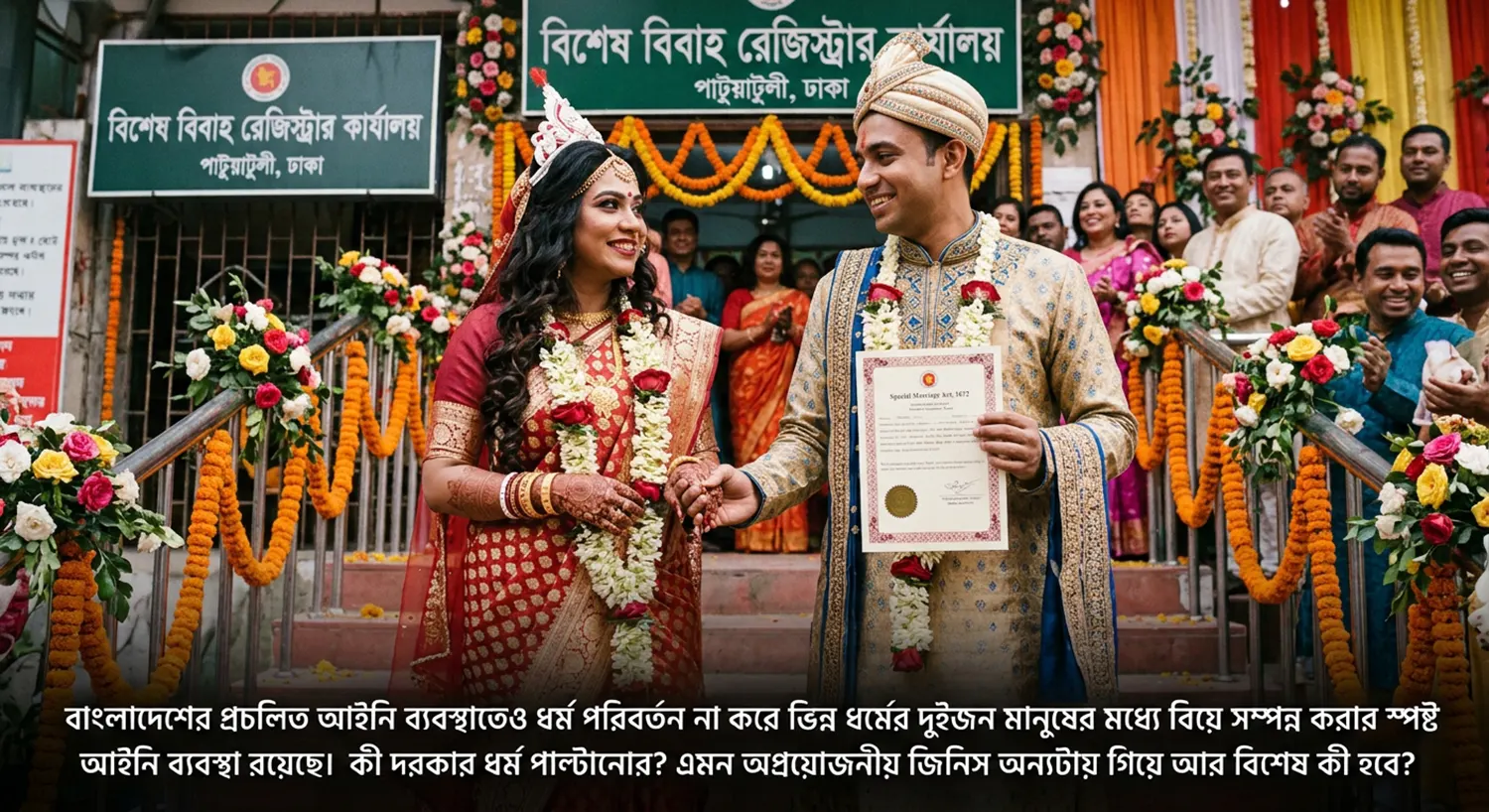
Non Religious Marriage
Bangladesh’s Special Marriage Act Provides Legal Protection for Interfaith Couples and Non-Religious Individuals to Marry
When discussions of love or marriage arise in Bangladesh, one question keeps coming back: can two people of different religions legally marry at all? On social media, some say, “Marriage is impossible without religious conversion.” Others argue, “Under the Special Marriage Act, no one needs to change religion, and everyone should know that.” Both sides are partly right and partly wrong. The truth lies in the wording of the law and its provisions, especially in a small declaration form that is often left out of the discussion.
This article explains the history of the law, who can marry under it, the conditions and procedure, the legal consequences after marriage, and the limitations of the law, based on the actual text of the legislation.
1. Background of the Law
The Special Marriage Act, 1872 (Act No. III of 1872) was enacted in British India on 18 July 1872. The preamble states that its purpose is to provide a form of marriage for persons who do not profess the Christian, Jewish, Hindu, Muslim, Parsi, Buddhist, Sikh, or Jain religion. It also applies to persons who profess the Hindu, Buddhist, Sikh, or Jain faiths. According to Section 1, the Act extends to the whole of Bangladesh. In 1973, the word “Pakistan” was replaced with “Bangladesh,” but the basic structure of the law remained unchanged.
Marriage laws in Bangladesh are primarily religion-based. Muslims marry under Muslim personal laws and the Muslim Marriages and Divorces (Registration) Act; Christians under the Christian Marriage Act, 1872; and Hindus under the Hindu Marriage Registration Act, 2012. For those who cannot marry under these religious systems while retaining their legal status, this 1872 Act is the only legal avenue for a civil marriage.
2. Who Can Marry Under This Act?
This is the central issue in the entire discussion. Section 2 of the Act refers to two distinct categories of people.
First Category: Persons neither of whom professes the Christian, Jewish, Hindu, Muslim, Parsi, Buddhist, Sikh, or Jain religion. In other words, individuals who do not adhere to any of these religions or who have renounced their previous religion.
Second Category: Persons each of whom professes the Hindu, Buddhist, Sikh, or Jain religion. For example, a Hindu and a Buddhist may marry under this Act while continuing to follow their respective religions.
It is important to note that Islam, Christianity, Judaism, and the Parsi faith are not included in the second category. Those persons must make a declaration that they are non-religious. For couples in love who wish to marry, this may not seem like a significant issue.
The Declaration: Where the Religious Question Is Determined
Under Section 10 of the Act, before the marriage is solemnized, the bride, groom, and three witnesses must sign a declaration before the Registrar in the form prescribed in the Second Schedule. The declaration takes one of two forms: either “I do not profess the Christian, Jewish, Hindu, Muslim, Parsi, Buddhist, Sikh, or Jain religion,” or “I profess the Hindu, Buddhist, Sikh, or Jain religion.”
The result is as follows:
- Hindu and Buddhist (or Sikh, Jain) couples may use the second declaration and marry while retaining their respective religions.
- For couples such as Hindu-Muslim, Muslim-Christian, or Christian-Hindu, the second declaration is unavailable because Islam and Christianity are not included in that list. Each person must sign the first declaration, meaning they must legally declare that they do not profess any of the specified religions.
In The Daily Star’s “Your Advocate” column, Supreme Court lawyer Barrister Omar Khan Joy clearly stated that two adults of different religions may marry under this Act, but only after declaring themselves non-believers. The same column notes that if a woman declares herself Hindu, she cannot marry a Muslim man under this law because Islam does not appear in the second part of the declaration. Another legal column published in 2010 explained the case of a couple who married under this Act and continued practicing their respective religions at home. According to the lawyer, however, in legal records they are considered followers of no religion because of the declaration they signed. He also called for reform of the law.
Therefore, the statement “no religious conversion is required” is not entirely accurate in the case of a Hindu-Muslim marriage. It is true that neither party has to convert to another religion. However, they must legally disclaim their religious affiliation in the declaration, and that is the real legal requirement. They may continue to practice their religion personally in belief and daily life, but the declaration remains part of the official legal record. Its legal implications are discussed later.
3. Conditions of Marriage
Section 2 imposes four conditions:
- Monogamy: Neither party may have a living spouse at the time of marriage. Unmarried persons, widows, widowers, and divorced persons may marry. If a person marries under this Act while already married, the marriage is void, and under Section 15, the act constitutes an offence punishable under Sections 494 or 495 of the Penal Code. Under Section 16, any subsequent marriage while a spouse is living also carries the same penalties regardless of religion. Thus, polygamy is not permitted under this Act.
- Age: The original text of the Act requires a minimum age of 18 for males and 14 for females, reflecting the standards of 1872. However, under the Child Marriage Restraint Act, 2017, a male under 21 or a female under 18 is considered a minor for marriage purposes. Registrars appointed under the Special Marriage Act may also be penalized for registering a child marriage. In practice, therefore, the groom should be at least 21 and the bride at least 18 years old.
- Guardian’s Consent: According to the text of the Act, a party under 21 years of age requires the consent of a father or guardian, and such guardian must also sign the declaration under Section 10 (except in the case of a widow). This raises questions regarding women aged 18 to 20. The provision appears inconsistent with the Age of Majority Act, 1975, which grants majority at 18 years of age. It is advisable to discuss this issue with the Registrar in advance.
- Prohibited Degrees of Relationship: The parties must not be related by blood or affinity in any way that would render the marriage invalid under the law applicable to either of them. According to the second proviso, marriage is prohibited where the parties share a common ancestor closer than the “great-great-grandparent” level, or where one party is a direct ascendant of the other or a sibling of such an ascendant.
4. Marriage Procedure Step by Step
Step 1: Notice to the Registrar (Section 4)
The bride or groom submits a written notice. The notice must be given to a Registrar within whose jurisdiction at least one of the parties has resided for the preceding 14 days.
Step 2: Entry in the Marriage Notice Book (Section 5)
The Registrar files the notice and enters a copy into the official Marriage Notice Book. The book is open for public inspection free of charge.
Step 3: Fourteen-Day Waiting Period and Objections (Sections 6–9)
The marriage may be solemnized after 14 days if no objection is raised. Any person may object on the ground that one of the four conditions in Section 2 has not been satisfied. If an objection is made, the Registrar must wait an additional 14 days. During that period, the objector may institute a declaratory suit in a civil court, and the marriage remains suspended until the court decides the matter. If the objection is found to be unreasonable and not made in good faith, the court may impose a fine on the objector. Religious or social objections, by themselves, are not valid legal grounds for objection.
Step 4: Signing the Declaration (Section 10)
The bride, groom, and three witnesses sign the declaration before the Registrar, who countersigns it. Under Section 21, knowingly making a false declaration may result in punishment under Section 199 of the Penal Code.
Step 5: Solemnization of the Marriage (Sections 11 and 12)
The marriage is solemnized in the presence of the Registrar and three witnesses. It may follow any form or ceremony, provided that each party declares to the other, “I take thee to be my lawful wife (or husband).” The marriage may take place in the Registrar’s office or at another location within a reasonable distance from it.
Step 6: Certificate (Sections 13 and 14). After the marriage, the Registrar enters a certificate in the Marriage Certificate Book, which is signed by the bride, groom, and three witnesses. This record is admissible in court as evidence of the marriage, and certified copies may be obtained upon application and payment of the prescribed fee. Under Section 13A, Registrars periodically submit marriage information to the Registrar General of Births, Deaths, and Marriages.
Where Does the Marriage Take Place?
The Act authorizes the government to appoint one or more Registrars. According to available information, the process is generally conducted through the office located in Patuatuli, Old Dhaka, and some lawyers serve as Special Marriage Registrars. The names, addresses, and fees of Registrars may change over time. Therefore, before proceeding, applicants should verify current information directly with the Ministry of Law or the Registrar’s office rather than relying solely on information found on social media. Marriages under this Act are not conducted in a Muslim marriage registrar’s office (Kazi Office) or a Hindu marriage registrar’s office, as those officials are appointed under different laws.
Main Traditional Office (Old Dhaka) – Address: 2/3 Loyal Strip (Brahmo Samaj Building), Patuatuli, Kotwali, Dhaka-1100 (located in the Sadarghat/Patuatuli area of Old Dhaka).
5. Legal Consequences After Marriage
A marriage certificate and wedding photographs are not the end of the matter. Several legal consequences follow from a marriage under this Act, and understanding them beforehand can prevent future complications.
Divorce
Under Section 17, marriages solemnized under this Act are governed by the Divorce Act, 1869. Divorce therefore occurs through the courts on legally recognized grounds rather than through religious procedures.
Inheritance
Section 24 provides that where a Hindu, Buddhist, Sikh, or Jain person marries under this Act, the succession to the property of that person and of the children of the marriage is governed by the Succession Act, 1925. In other words, a secular inheritance regime applies instead of the relevant religious personal law. I have not found a clear and up-to-date source explaining how courts currently address inheritance for persons who declare themselves non-believers under the Act. Where significant property interests are involved, obtaining legal advice in advance is prudent.
Joint Family Status and Adoption
Under Section 22, a Hindu, Buddhist, Sikh, or Jain member of an undivided family who marries under this Act is deemed to have severed membership in that family. Under Section 25, such a person loses the right to adopt. These provisions may also affect the distribution and management of family property.
Religious Identity of Children
I found no provision in the text of the Act directly determining the religion of children born of such marriages. Section 18 merely provides that, for purposes of prohibited degrees of relationship when such children marry under the Act, the father’s law shall apply. Therefore, questions concerning religious identity, guardianship, or religious instruction are matters that families should discuss and settle in advance.
Risk of False Declaration
Under Section 21, knowingly providing false information in the declaration constitutes an offence punishable under Section 199 of the Penal Code. For this reason, no one should sign the declaration without fully understanding its contents.
6. Limitations and Calls for Reform
The Act is more than one hundred and fifty years old, and legal commentators have long highlighted its limitations.
First, there is the issue of religious identity. A legal article published in The Daily Star in 2009 stated that marriage under this Act requires relinquishing one’s religious status and referred to the precedent reported in 18 DLR 509. In 2010, a lawyer writing in the same newspaper’s legal column argued that the law does not permit Hindu-Muslim marriages while preserving both parties’ religious identities, and he called for legislative reform.
Second, there is conflict with personal laws. Marriage and family matters in Bangladesh are generally governed by religion-based personal laws. Barrister Omar Khan Joy wrote in The Daily Star that where both parties retain their respective religious identities, the existing legal framework does not recognize the marriage. This is the central gap in the law. Bangladesh still lacks a fully recognized civil marriage system allowing two adults to marry while maintaining their distinct religious identities.
Third, there are inconsistencies in the age requirements. The original text of the 1872 Act, the Child Marriage Restraint Act, 2017, and the Age of Majority Act, 1975, do not align with one another. The 2017 Act also contains provisions allowing marriage below the standard age in special circumstances with court approval, a matter that has attracted international criticism. A report by Plan International has likewise noted inconsistencies in these legal age requirements.
Fourth, there is the social reality. Even where a legal pathway exists, family and societal pressure remains the principal obstacle for many couples. Accounts published in an Indian news outlet describing the experiences of Bangladeshi couples illustrate these pressures. Legal knowledge is therefore necessary, but not sufficient.
9. Conclusion
The Special Marriage Act, 1872 is indeed still in force in Bangladesh, and it remains the only legal pathway for a civil marriage between persons of different religions. Those who claim that such marriages are impossible are mistaken. At the same time, those who argue that nothing needs to be given up are not stating the whole truth. A Hindu-Muslim couple must sign a declaration stating that they do not profess any religion specified in the Act, and that choice may affect issues such as divorce, inheritance, and the legal status of children.
The advantages of the Act are legal recognition, an official marriage certificate, and the protection of monogamy. The price is the declaration requirement and the legal complexities that may follow.
Practical Advice for Couples Considering This Route
- Before proceeding, obtain and read the notice form and declaration form from the Registrar’s office.
- Understand what declaration each party will make, and discuss the legal consequences together beforehand.
- Verify the office address, fees, required documents, and witness requirements directly with the relevant authority.
- If property, children, or international relocation is involved, consult a lawyer experienced in family law.
- After the marriage, obtain certified copies of the marriage certificate and keep them in a secure place.
Related Posts
বাংলাদেশের বিশেষ বিবাহ আইন দুই ধর্মের মানুষ বা নিধার্মিকদের বিয়ের সুরক্ষা দেয়
বাংলাদেশে প্রেম বা বিয়ের আলোচনা উঠলে একটি প্রশ্ন বারবার ফিরে আসেঃ ভিন্ন ধর্মের দুজন মানুষRead More
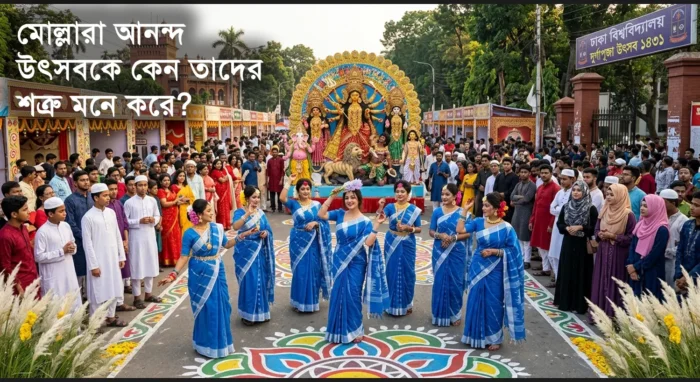
Why do Islamist clerics consider Bengali cultural festivals their enemy?
This year, unlike many previous years, the major Hindu religious festival Durga Puja in BangladeshRead More
ইসলামিস্ট মোল্লারা কেন বাঙালিদের আনন্দ উৎসবকে তাদের শত্রু মনে করে?
এবার বাংলাদেশে অন্যবারের তুলনায় বেশ শান্তিপূর্ণ, উৎসবমুখর পরিবেশে হিন্দু ধর্মের বড় ধর্মীয় উৎসব দূর্গাপূজা হয়েRead More
Comments are Closed