
No Festivals in Islam
Why do Islamist clerics consider Bengali cultural festivals their enemy?
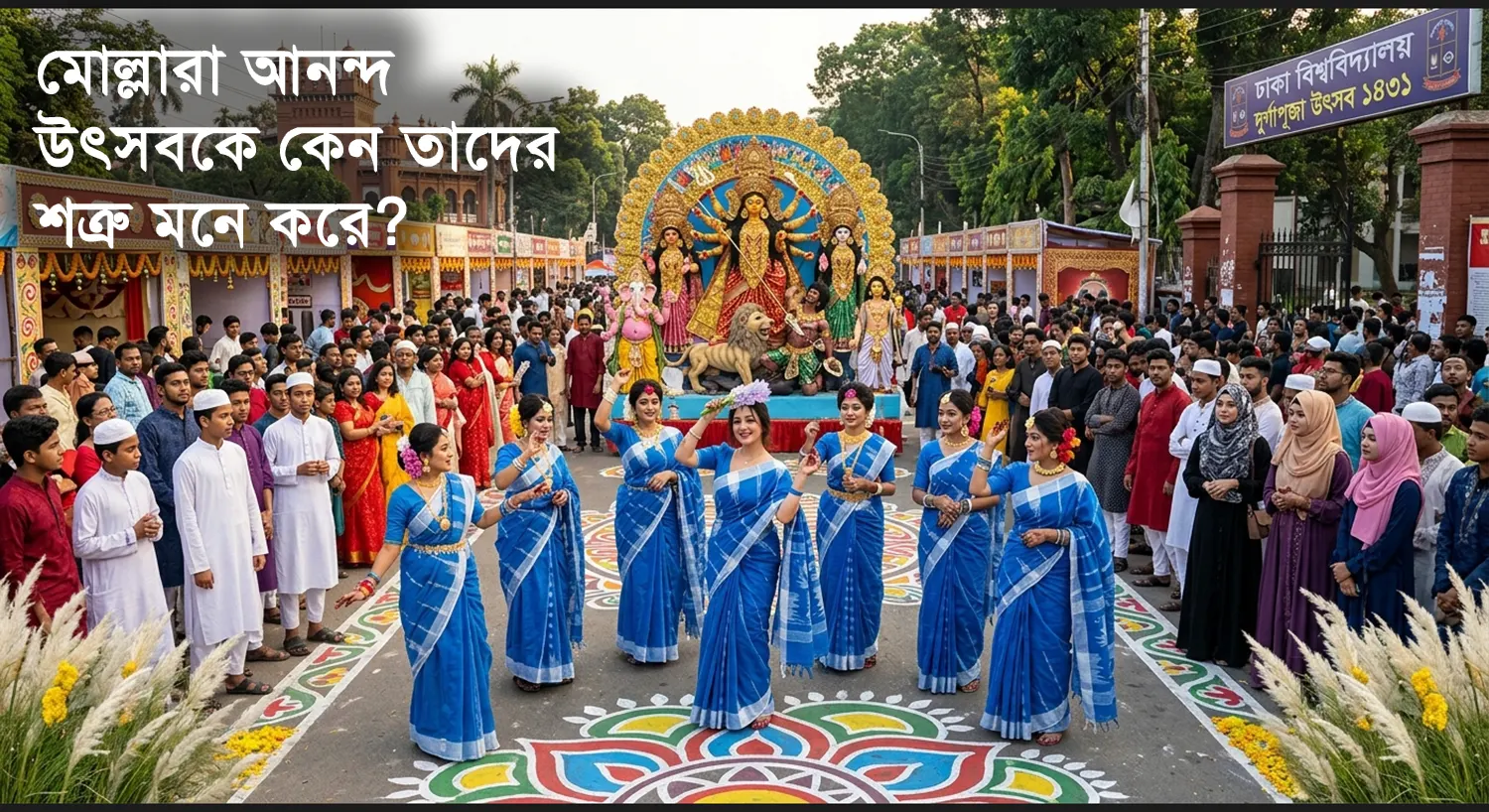
This year, unlike many previous years, the major Hindu religious festival Durga Puja in Bangladesh was celebrated in a peaceful and festive environment. As per the yearly pattern, some Islamic opportunists did vandalize a few idols, but no major conflict or bloodshed occurred. The most hopeful thing was that many celebrities openly joined and supported the Sharadiya Durga Puja celebrations. Whatever one’s religious belief may be, unless someone is an extremist, if Bengali blood runs through their veins, it is hard to ignore the colors, beauty, music, gatherings, and accompanying fairs of this festival. Without the pull of the festival, no one would want to cross Dhaka’s endless traffic from one end to the other just to see artistic craftsmanship. Everyone joins this festival out of heartfelt attraction; there is no other festival in Bengali life as colorful as this. I used to go too—during COVID, even 2–3 times a day. I miss it now.
When we were young, in our village on the evening of Shab-e-Barat, all the boys and girls would go house to house eating khichuri, halua, and batasha. That day we could take a break from studies. It was a very joyful occasion. Gradually, the clerics began preaching—celebrating Shab-e-Barat is forbidden; one must spend the whole night in worship; Allah descends to the lower heaven that night to hear the calls of His servants, He cannot hear people’s cries from afar. Let me mention, Allah’s appearance is like a human; 1400 years ago, when Prophet Muhammad or the Arabs imagined something more powerful than humans, a human-like form appeared in their minds. Allah has human-like hands and feet; He sits with His back on a throne called the Arsh. Poet Nazrul even wrote “piercing the throne of God…” and wanted to insert a spear under Allah’s throne, pierce His backside, and come out with his head. Anyway, over time, due to the dominance of radical Islam, the joyful occasion of Shab-e-Barat disappeared from village life. Even in cities, that joy now faces obstacles at every step.
On the day before Eid-ul-Fitr, going to the village field in groups to sight the moon was a tradition. On both Eids, waking up early, bathing, eating semai, going to the Eidgah, buying papad, returning home, changing clothes, and then focusing on daily chores—this was our childhood Eid. It cannot exactly be called a festival. On Eid-ul-Fitr, boat races were held on the river along the India–Bangladesh border. People from both sides organized it. Older boys would ride bicycles in groups to the border to watch the boat race. Now that probably doesn’t happen. When everyone says “Eid joy”—I wonder, what exactly is Eid joy?
For us, the biggest festival was Pahela Baishakh. The day after Pahela Baishakh (the day it is celebrated in India), the largest Baishakhi fair in the subdistrict was held in the neighboring village. As children, we eagerly waited for that day. Throughout the year, everyone saved 1/2/3/4/5/10/20 taka to buy toys at the fair. Some elders in the village would say—“That’s a Hindu fair, no need to go.” On the way, there was a Hindu neighborhood; they all went to the fair, but we couldn’t understand what exactly the fair had to do with Hindus. Of course, no one listened to the prohibition. All married daughters, sons-in-law, and their children would come just to attend the fair. Everyone tried to go 1/2/3 times. Even during Ramadan, the fair used to spread across the entire football field and into adjacent areas. In 2021 and 2022, during Ramadan, I saw the fair barely occupying a corner of the field. Everything is now wrapped in religious restrictions. No one goes outside Islamic instructions, lest they miss out on heavenly maidens!
Durga Puja used to be held almost every year in the neighboring area. We went to the Puja fair. Village mothers, aunts, uncles would go in groups at night to watch the arati. Watching the priest wave his hands to the rhythm of the drums felt like the drumbeats were coming from the movement of his hands. During Puja, I saw Hindus traveling in groups from village to village for a week; the village dirt roads were filled with vans. To us, those scenes were unimaginable. In Chaitra, we went to the Hindu neighborhood to watch the Sannyasi dance. Many Muslim mothers wouldn’t eat mangoes until the Sannyasi arrived—I don’t know why. But Hindu–Muslim harmony was strong; everyone was invited to each other’s weddings, and people visited relatives in distant villages. As Islamic rules become stricter day by day, distance is increasing—Islam forbids friendship with non-Muslims, wishing them well, or helping them. Have you ever seen a prayer where Muslims ask for the well-being of people from other religions? If you have, let me know. You may pray for their guidance, but not their welfare—that is Islam. Earlier, radical Islam wasn’t practiced, so harmony remained; now clerics are destroying that harmony day by day.
Earlier, during Eid, everyone said “Eid Mubarak.” Now they say “Taqabbalallahu minna wa minkum.” Apparently, the companions used to say this on Eid day. Muslims believe the best thing is to remember Allah and Prophet Muhammad every second. Reminding Allah repeatedly that He is the only creator, with no partners, is considered the greatest virtue, anytime. So now saying “Eid Mubarak” is discouraged. Even the pronunciation of salam must be exactly like Arabs; Allah won’t understand your intention—if your Arabic pronunciation conveys a different meaning, you will burn in hellfire!
According to religious doctrine, Islam is culturally isolated. Strict Islamists rarely experience joyful moments. Religiously, they have no connection with festivals. The two days Muslims celebrate—Eid-ul-Fitr and Eid-ul-Adha—are not festivals in the sense we understand; they are acts of worship. Recently, a group called Ahl-e-Quran has emerged, who accept the Quran but reject Hadith. But rejecting Hadith invalidates both Eids. Fasting and sacrifice are acts of worship, not festivals. Only Muslims participate in these events. In Durga Puja, if a random passerby joins, no one asks their religion—can anyone from another religion join Eid events like that?
Because of cultural isolation, many Muslims focus on food during these days, though these days are purely for worship. After fasting 29/30 days, they constantly think about what to eat for sehri and iftar. Eating becomes the main issue. After fasting ends, they wake up early to pray; on Eid-ul-Adha, they sacrifice animals to prove piety and earn Allah’s satisfaction. But now it has become a red-meat festival; there is no trace of piety or worship.
These strict Islamists themselves realize they are culturally isolated. That’s why they look gloomy when others enjoy festivals, music, food, and celebrations. If they ever become the majority, they dream of shutting these down, or wait for them to disappear. Their tendency is—“If we don’t have it, others shouldn’t either.” It’s not really their fault. For this reason, they run coordinated campaigns against Pahela Baishakh, and if any Muslim joins Puja celebrations, they drown them in insults. They fear—if Bengalis immerse themselves in Puja celebrations, they may stop giving alms to clerics; if Bengali culture spreads, their unscientific lunar Hijri calendar may vanish from Bengali life! If Bengalis return to their cultural roots, clerics may lose their livelihood. So they remain silent on many issues but run coordinated campaigns against Puja and Pahela Baishakh to label them as non-Islamic innovations. Their coordinated propaganda works—you can see many young people echoing their tone on social media, insulting and threatening people like us.
Humans have been sensitive to festivals since ancient times. Melodious voices, rhythm, tune—these have evolutionary significance. Take Bengalis! The tagline is “thirteen festivals in twelve months.” Bengalis have Bhatiali, Bhawaiya, Jari–Sari, Puthi recitation, Jatra, Pahela Baishakh, Durga Puja, monsoon festivals, Nabanna, Poush Mela, Basanta Utsav, boat races, Baul festivals, national pitha festivals, bioscope, concerts, kite festivals—countless occasions for joy. But many Bengalis, once they become Muslims, religiously cannot participate in these. Because Islam forbids literature, culture, music, sports—everything. Only literature and culture praising Allah and Prophet Muhammad are allowed. Only three games are permitted—playfulness with one’s wife, horse riding, and archery training. No other games are allowed. Drawing pictures, taking photos, posting photos on Facebook, sharing videos—all are forbidden. A video is just a collection of many still images.
Many urban moderate Muslims tried to create unity by promoting Milad-un-Nabi, Shab-e-Barat, etc., but these attempts failed. They tried to create a festive vibe with fireworks, but it didn’t work. Because these have no religious basis; Prophet Muhammad never celebrated these as festivals. Eating halua-roti and raising blood sugar has no significant value. When asked about his birthday, Muhammad said he was born on a Monday, so he fasts on Mondays—again an act of worship. But these so-called moderate Bengali Muslims skip fasting and feast on his birthday.
Essentially, there is a conflict between Bengali culture and strict Islamic practice. A Bengali can never become a strict Muslim, and a strict Muslim can never become Bengali by abandoning religious restrictions. On the other hand, Bengali Hindus have many flexible festivals—Durga Puja, Kali Puja, Saraswati Puja, Rath Yatra, Dol Yatra, Janmashtami, Kojagari, Lakshmi Puja, Bhai Phonta—many more! You can instantly attend these, join their joy, and share happiness. Religious Muslims do not have that opportunity. In Kolkata, Christmas is celebrated with great enthusiasm; Hindus from all over the world join without issue. But as a Muslim, you cannot post a Christmas wish—you will be flooded with insults, because Islam does not permit it.
As I said earlier, there is a conflict between Bengali culture and devout Muslim identity. Acknowledging this conflict, many Muslims say—“I am Muslim first, then Bangladeshi.” Because they know—there is no such thing as a Bengali Muslim. Their first and only identity is Muslim. Even those who do not practice properly, even half-dressed women, write “Proud Muslim” or “Muslim Bangladeshi” on their profiles. Because they are aware of this conflict. Even if they do not practice properly, their faith is intact. And having intact faith means—they will go to heaven one day. People of other religions may do good deeds all their lives but will not go to heaven, because they never said—Allah is the creator, He has no partners, and Muhammad is His messenger! This one sentence will take even the world’s worst murderer, genocider, or rapist Muslim to heaven, where Abbas, Azhari, Sayeedi, Ghulam Azam, Nizami, Ahmadullah will already be present. Meanwhile, Mother Teresa, Newton, or someone who never harmed anyone—will burn in hell forever.
In pre-Islamic times, poetry gatherings were held around the Kaaba; the best poems were hung on its walls; there were female singers, poets like Asma bint Marwan. But after Muhammad’s prophethood, everything ended. Strict Muslims oppress minorities in various ways—this is the outcome of cultural isolation. A culturally strict Muslim is crippled; disconnected from the world; his main aim is the afterlife. That’s why Muhammad destroyed the idols preserved in the Kaaba; even today, strict clerics say—they did not come to build idols, they came to break them. They say this publicly in Bangladesh, in front of hundreds of thousands of people. As a result, idol vandalism happens multiple times every year, though this year it was less. Hindus have witnessed brutal violence like the blood-soaked Sharad; this year they got some relief.
While people of all religions—men, women, children—celebrate various festivals, a strict Muslim stands at the window with a gloomy face watching these joyful moments. It creates psychological pressure on him; he shrinks inside. That’s why, when he gains power, he invades others, oppresses them, and wants to impose his dominance. For this reason, they cannot tolerate festivals like Durga Puja, concerts, Baul gatherings, Pahela Baishakh. I have been writing about this since 2013, but since I am not popular, my writing has no impact anywhere.
Related Posts
ইসলামিস্ট মোল্লারা কেন বাঙালিদের আনন্দ উৎসবকে তাদের শত্রু মনে করে?
এবার বাংলাদেশে অন্যবারের তুলনায় বেশ শান্তিপূর্ণ, উৎসবমুখর পরিবেশে হিন্দু ধর্মের বড় ধর্মীয় উৎসব দূর্গাপূজা হয়েRead More
Why do Islamist cyber‑jihadis insult, threaten, and file false reports against people with different opinions?
Maulana Azhari once advised Islamists that sharing his Facebook posts is also an Islamic act;Read More
ইসলামের সাইবার জিহাদিরা কেন ভিন্নমতের মানুষকে গালি দেন, হুমকি দেন, মিথ্যা রিপোর্ট করেন?
মাওলানা আজহারি একবার ইসলামিস্টদের উপদেশ দিয়ে বলেছিলেন – তার ফেসবুক পোস্ট শেয়ার করাও ইসলামের কাজ;Read More
Comments are Closed