
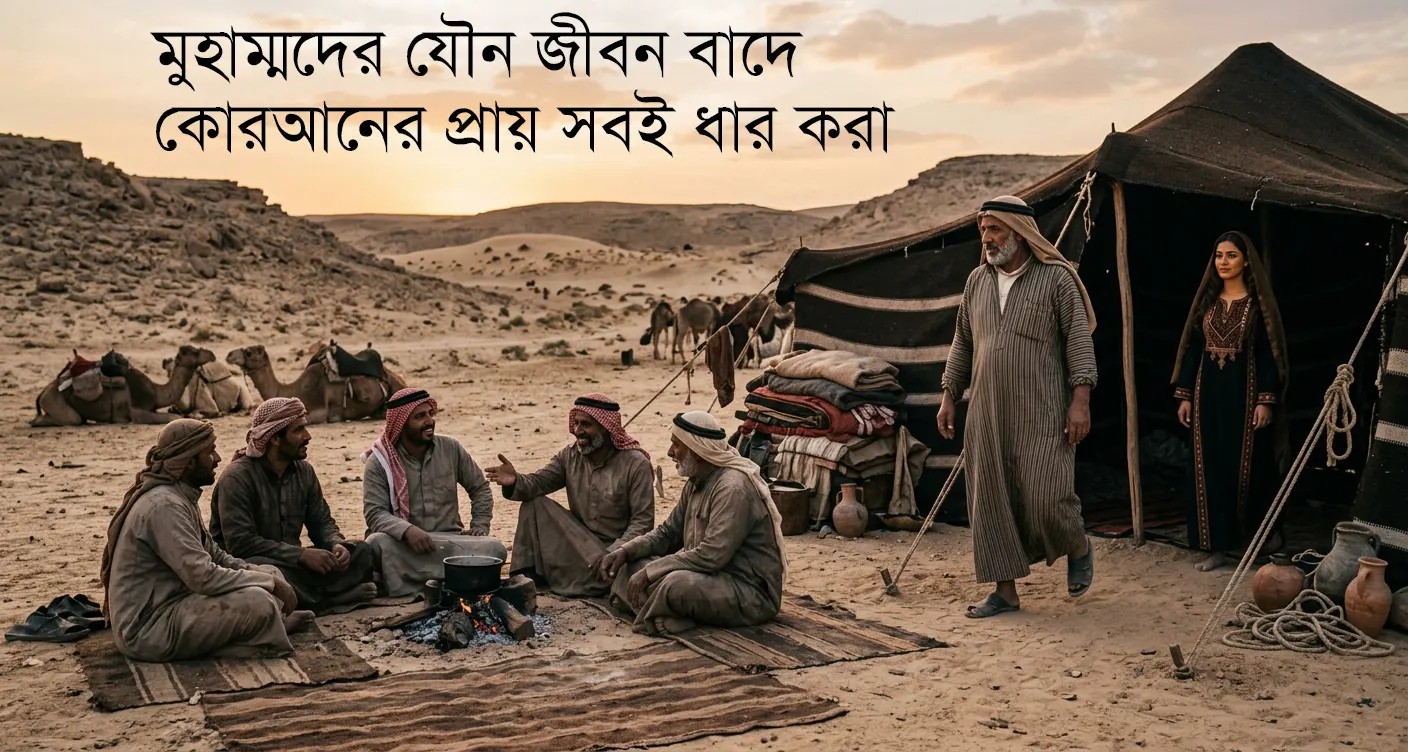
Muhammad’s Entire Narrative is Borrowed
Except for Muhammad’s sexual life, almost everything in the Qur’an is borrowed! Nobody knew that Muhammad was such a great kutub
1400 years ago, in the harsh, famine‑stricken Arabia, scattered Bedouin people lived there. Because the desert cities of Mecca and Medina were commercial junctions of prosperous civilizations, the folk tales, mythological stories, and religious traditions of Roman, Persian, Syriac, and Hebrew cultures were widely circulated among the people of Arabia by word of mouth. Since there was no distinct written or rich history of their own, the ideas and myths of neighboring regions had a deep influence on Arabia at that time, and this influence is clearly reflected in the various historical or mythological narratives described in the Qur’an—Muhammad’s preached message—and in the hadiths about events in his life. Even if you wanted to, you would not be able to show any neutral history where Arabia has any historical role or influence. Even the fact that Muhammad was becoming such a great hopa or the greatest kutub in the world—such a big piece of information—was unknown to the people of any surrounding prosperous civilization. In any institutional urban civilization or historical source, there is no existence of Islam or Muhammad. Muhammad had become such a great kutub, yet until Islamic militant jihadi forces were sent out for conquest, nobody anywhere in the world knew about him.
In the Qur’an and hadith, Muhammad’s own additions are very few. Muhammad only added those things from himself where there would be arrangements to satisfy his immense sexual desires, where instead of building a productive economy, an economy of plunder through jihad would be established, and where the system of buying and selling slaves and sex slaves would be strengthened. Even then, while Khadija was alive, Muhammad suppressed all these desires because of Khadija’s influence and power. For example, consider that in his childhood Muhammad proposed marriage to his cousin Umm Hani, his childhood crush. His uncle Abu Talib rejected that proposal with contempt, because Muhammad was a vagabond. Later, when Muhammad became a hopa, that old love flared up again. One day, when Umm Hani’s merchant husband went to Syria on business, that night Muhammad spent the night in Umm Hani’s room. In the morning, when the companions could not find Muhammad all night, at dawn they saw Muhammad’s sandals in front of Umm Hani’s room. Then Muhammad came out and spun the story of the Zoroastrian religious figure Arda Viraf’s ascension (mi‘raj). From Umm Hani’s room itself he claimed to have gone to Jerusalem, led prayer at Bayt al‑Maqdis, met with Allah, seen heaven and hell, seen that almost everyone in hell is a woman—so many tales! As I was saying, he brought down verses in the Qur’an to fulfill his taste for pedophilic sex by marrying his friend’s 6‑year‑old daughter Aisha and having intercourse with her at the age of 9.
If you remove all these marriages of Muhammad, his sexuality, sex slaves—then almost everything else in the Qur’an and hadith is borrowed. It is the entry of surrounding civilizations. This exchange was not at all equal—rather it was essentially one‑sided. The Byzantine Empire, Sasanian Persia, Jewish and Syriac Christian communities—these were the prosperous, urban‑centered, institutional civilizations of that time, which had states, written literature, theological schools, and extensive trade networks. In contrast, most regions of Hijaz and central Arabia were desert, barren, and sparsely populated—there was almost no surplus agricultural economy to speak of, and there were repeated famines and water shortages. For this reason, there are so many promises of water, rivers, shady trees, and date orchards in paradise. Before the seventh century, Arabia had not developed any indigenous written literary tradition, centralized state system, or institutional knowledge structure—it was mainly a culture based on oral poetry and tribal memory.
As a result, the flow of influence was almost entirely from the outside to the inside—that is, the Arabian Peninsula absorbed the religious‑cultural elements of neighboring civilizations, but could not spread any comparable influence outward. Trade centers like Mecca and Medina were essentially transit points—junctions on the caravan routes from Yemen to Syria—through which, along with goods, stories, legends, and religious ideas also flowed. But this flow was mainly one‑way import, not export. Jewish settlements (such as in Yathrib, i.e., Medina) and Christian centers like Najran locally spread their scripture‑based stories and folk tales, which, instead of remaining in written form, were transmitted orally, becoming distorted, abridged, or transformed, and then blended into local narratives.
This unequal relationship explains why in stories like Gog and Magog (Yajuj‑Majuj), the People of the Cave (Ashab al‑Kahf), or the people of Lot, we find almost identical structures of Byzantine‑Syriac or Jewish origin, whereas in the opposite direction—Arab folk tales entering Byzantine or Persian religious literature in the pre‑Islamic era—historians hardly find such examples. Arabia at that time was a recipient, not a source center—and this geographical‑economic marginality explains why the region’s own knowledge reservoir was so limited, and why external narratives were so easily, almost without verification, assimilated into the local belief system.
Related Posts
মুহাম্মদের যৌন জীবন বাদে কোরআনে প্রায় সবই ধার করা! মুহাম্মদ যে এতো বড় কুতুব কেউ জানতো না সেটা!
১৪০০ বছর আগের রুক্ষ দূর্ভিক্ষপীড়ত আরবে ছড়িয়ে ছিটিয়ে বেদুঈন মানুষের বাস ছিল। মরুভূমির মক্কা ওRead More
Amazing Islamic Science! The infinite powers of jinn and the Islamic formula for using them to advance human civilization
During General Zia-ul-Haq’s era, there was a bumper harvest of Islamic science in Pakistan. InRead More
বিষ্ময়কর ইসলামিক সায়েন্স! জিনদের অসীম ক্ষমতা ও তাদের ব্যবহার করে মানব সভ্যতা উন্নয়নের ইসলামি ফর্মুলা
জেনারেল জিয়াউল হকের আমলে পাকিস্তানে ইসলামিক সায়েন্সের বাম্পার ফলন হয়েছিল। ১৯৮৭ সালে পাকিস্তানের সরকারি অর্থায়নেRead More
Comments are Closed