
Islam and Pseudoscience
Amazing Islamic Science! The infinite powers of jinn and the Islamic formula for using them to advance human civilization
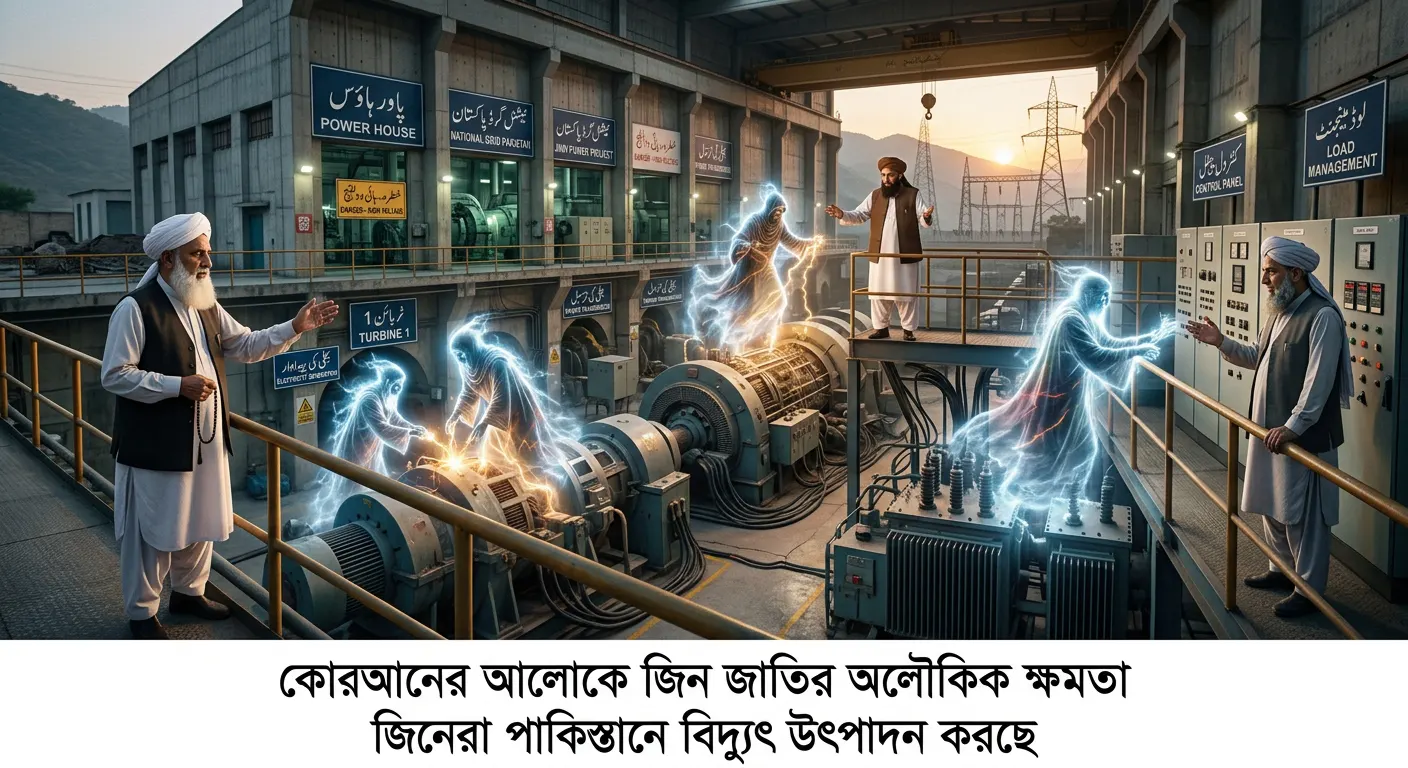
During General Zia-ul-Haq’s era, there was a bumper harvest of Islamic science in Pakistan. In 1987, with government funding and through the joint initiative of the government agency “Pakistan Council for Scientific and Industrial Research” (PCSIR) and the International Islamic University, an international scientific seminar was organized in Islamabad. The main theme of this seminar was “Quranic Scientific Interpretation.” Many Islamic research papers and proposals were submitted to the seminar under scientific names. Most of the research and proposals were about jinn. In this seminar and later to the government, a proposal was submitted regarding generating electricity using jinn by one of Pakistan’s top nuclear scientists! His name was Sultan Bashiruddin Mahmood, a senior nuclear engineer at the Pakistan Atomic Energy Commission (PAEC), who served as the Director of a major project. He claimed that by capturing jinn and harnessing their energy, electricity could be produced.
Mahmood was not just any ordinary person. He earned advanced degrees in Electrical Engineering from the University of Engineering and Technology (UET), Lahore, and the University of Leeds in the United Kingdom. In the 1960s, he joined the Pakistan Atomic Energy Commission (PAEC). He served as the Director of one of the country’s most important nuclear facilities, the “Khushab-I” nuclear reactor project. For his contributions to the nuclear field, the Pakistani government awarded him one of the country’s highest civilian honors, the Sitara-i-Imtiaz. Mahmood’s primary area of research was the Quran. His claim was that since jinn are a type of “pure energy or flame,” according to the laws of energy transformation, this energy could be converted into electrical energy. He proposed that through special technology, jinn could be captured or controlled, and their boundless energy could be extracted. He said that if this project succeeded, Pakistan’s perpetual electricity and energy crisis would be solved instantly.
Islamists have an endless fetish for jinn. All of it originates from the Quran and Hadith. The Quran contains numerous verses and even an entire surah about jinn – 6:100, 6:112, 6:128, 6:130, 7:38, 7:179, 15:27, 17:88, 18:50, 27:17, 27:39, 34:12, 34:13, 34:14, 41:25, 46:29, 46:30, 46:31, 46:32, 51:56, 55:15, 55:33, and the entire Surah 72 (Surah Al-Jinn, verses 1–28). I am not listing them in detail; those who need them can check. And not just the Quran. Sahih Muslim 450a–450b (Laylatul-Jinn / the Prophet reciting Quran to the jinn), Sahih Muslim 3030d (about jinn worship), Sahih Bukhari 731/3284 (an ifrit jinn tried to disrupt prayer), Sahih Bukhari 773/4921 (context of Surah Al-Jinn’s revelation), Sahih Bukhari 583 (adhan is heard by both humans and jinn), Sahih Muslim 2996 (bones and animal dung as food for jinn), Sahih Muslim 768a–768c (the Prophet’s encounter with jinn and Quran recitation), Sahih Muslim 532 (jinn and shaytan references). Additionally, descriptions of the creation, types, and characteristics of jinn appear in various other Hadith collections.
And not just Pakistan. In Bangladesh and all other Islamic countries, countless incidents occur involving jinn. Hundreds of millions of taka are exchanged over jinn-related matters, fraud occurs, rape occurs. Bangladesh’s famous Islamic scientist Maulana Tarek Monowar claimed that America’s Belladonna Bridge in Washington and many other structures were built by jinn – youtu.be/JTTSa7Nd-kU. And not just Tarek Monowar; no Islamist cleric misses the chance to talk about the existence and power of jinn. But what exactly are these jinn–ghost–spirits described in Islamic science?
Belief in jinn is a central element of Islamic theology as mentioned in the Quran and Hadith, and these have been the primary sources of jinn studies for Islamists for 1400 years. These beings are described as invisible, created from smokeless fire, and living in a parallel world to humans. The problem is that these claims are structured in such a way that they are nearly impossible to verify through experimentation – neither provable nor falsifiable. According to the burden of proof, science is not obligated to prove or disprove the existence of jinn; it is unnecessary. A fundamental requirement of the scientific method is falsifiability, which is absent in claims about jinn. This is why, despite challenges worth millions of dollars, no one has been able to prove the existence of jinn in a laboratory or controlled environment. No one educated in advanced countries sees jinn; only believers do, and even those experiences are identified in psychology as various human mental conditions.
In this context, the question arises: why do many professionals in Muslim countries—doctors, engineers, professors—cling to such beliefs? One explanation may be the socialization process formed from childhood. Religious education often begins at an age when a child’s critical thinking is not yet mature, and religious texts are presented as unquestionable authority. No matter how advanced institutional education becomes, it teaches rational methods in specific subjects but does not automatically re-evaluate religious beliefs acquired earlier—these two domains often remain stored in separate compartments in the mind. These Islamists hold rigid beliefs that even if science says otherwise, even if different logic and evidence are presented, the Quran and Hadith are infallible and cannot be wrong. Islam portrays Muslims as the best nation, the Quran as the best book, and Muhammad as the best human; even if Muslims commit countless crimes or contribute nothing to human civilization, only Muslims will go to heaven. From childhood, this superiority complex syndrome takes root. Then science itself seems false to them.
The social and economic consequences of this belief are also significant. As mentioned earlier, hundreds of millions of taka are exchanged over this. In Bangladesh and other Muslim-majority societies, religious figures conduct financial fraud in the name of jinn possession or “exorcism,” and in some cases, serious crimes like sexual assault have occurred under this pretext, as reported many times in the media. When an unproven supernatural belief merges with institutional authority and social trust, it becomes an effective tool for exploitation—especially in societies where questioning religious leaders is weak. So the issue may not be Islam itself, but the danger that arises when jinn or similar supernatural beliefs are merged with institutional power or policymaking. This tendency is not limited to one religion; it appears in various forms across different religions and cultures worldwide.
Sultan Bashiruddin Mahmood’s incident of “generating electricity from jinn” proves that holding high institutional education or a major scientific position does not make someone a true scientific thinker. When science abandons logic and evidence and becomes a servant of blind faith and political agendas, even the mind of a nuclear scientist can produce such absurd and laughable theories. This dark chapter in Pakistan’s scientific history is now used worldwide as a major example of the dangers of pseudoscience.
Mahmood was mentally an Islamic extremist. At one point, his extremist mindset became even more radical. After retiring from the Atomic Energy Commission in 1999, he founded an extremist organization called “Ummah Tamir-e-Nau” (UTN). After the September 11, 2001 terrorist attacks, he was arrested for attempting to pass Pakistan’s nuclear secrets and technology to Osama bin Laden and Al-Qaeda. Later, the United Nations included him in the list of international terrorists and froze all his assets and bank accounts. This controversial figure died in 2020.
But this one person is not the end; countless people fall victim to pseudoscience in the name of Islamic science. Those of us who avoid such pseudoscience and struggle to promote pure science also face threats to our lives. In countries like Bangladesh and Pakistan, the spread of pseudoscience in the name of Islamic science is increasing day by day. Under this very writing, you may find people who spend their entire lives defending such pseudoscience and would not hesitate to take the lives of people like us—because we stood with light against this darkness.
Related Posts
বিষ্ময়কর ইসলামিক সায়েন্স! জিনদের অসীম ক্ষমতা ও তাদের ব্যবহার করে মানব সভ্যতা উন্নয়নের ইসলামি ফর্মুলা
জেনারেল জিয়াউল হকের আমলে পাকিস্তানে ইসলামিক সায়েন্সের বাম্পার ফলন হয়েছিল। ১৯৮৭ সালে পাকিস্তানের সরকারি অর্থায়নেRead More

Allah’s hatred toward Jews and Christians – the cruel, genocidal Allah who is supposedly also Rahmanur Rahim, the Most Merciful!
Sahih Muslim 2767’s hadiths clearly state: From Abu Musa (ra): On the Day of ResurrectionRead More
আল্লাহর ইহুদি-খ্রিস্টান বিদ্বেষ – নিষ্ঠুর গণহত্যাকারী আল্লাহ নাকি আবার রহমানুর রাহীম, পরম দয়ালু!
সাহিহ মুসলিম ২৭৬৭-এর হাদিসগুলো স্পষ্টভাবে বলে: আবু মুসা (রা) থেকেঃ কিয়ামতের দিন আল্লাহ প্রত্যেক মুসলমানকেRead More
Comments are Closed