
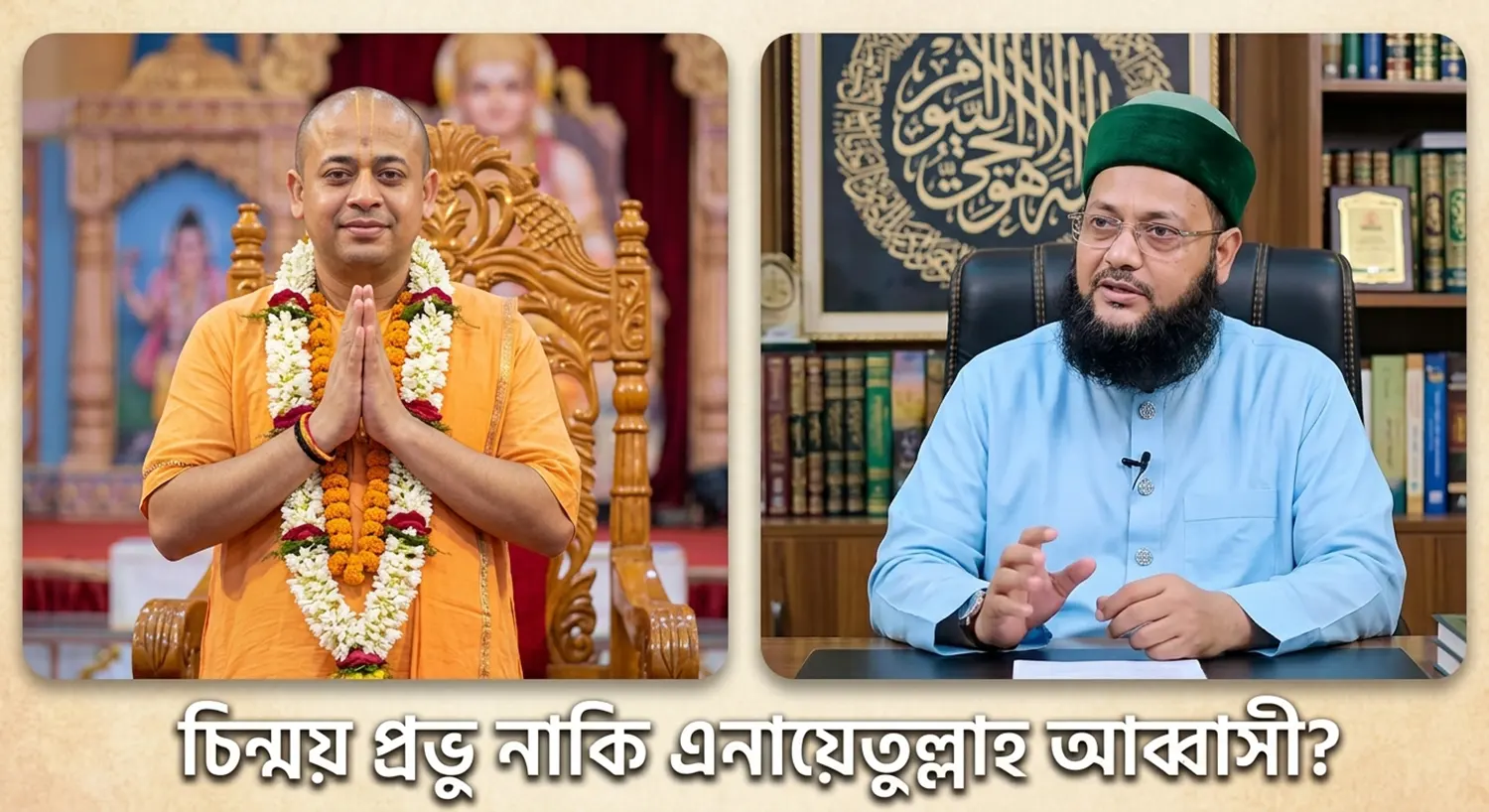
Abbasi vs Chinmoy
Chinmoy Krishna Prabhu or Enayetullah Abbasi?
From Bonn in Germany, I reached a local station to catch the last train to Berlin and saw that there was still an hour left before the train departed. The night was deep, the platform almost deserted, a light chill in the air, and the distant lights seemed to be staring out from within the fog. Behind the ticket counter sat a middle‑aged lady, her name tag read Isabella Schneider, and seeing me she called out with a warm smile.
“You’ll get bored sitting alone for so long. Come, let’s talk.”
There was a kind of warmth in her voice, as if the presence of another person on this deserted platform had reassured her a little too. I walked closer. She looked at my passport in my hand for a while, then raised her eyes and said,
“Bangladeshi? Wow! Listen, there’s a funny coincidence on today’s train. Two religious leaders from your country are returning to Berlin on this very train. There was an interfaith dialogue event in Bonn, and they were participants. Two separate compartments were allocated for them, along with their companions. There are a few empty seats in both compartments—one compartment is almost full, luxurious! And the other one is a bit empty, more basic. If you want, you can sit there.”
“Whose compartments? Who are they?” I asked.
The lady typed something on the computer keyboard, pressed Enter, and informed me, “One is Mr. Enayetullah Abbasi, and the other is Chinmoy Krishna Prabhu. Hearing your name, I thought you might feel more comfortable in Mr. Abbasi’s compartment—that one is quite modern and comfortable.”
I smiled slightly and shook my head.
“No, Isabella Schneider. I would rather take a seat in Chinmoy Krishna Prabhu’s compartment, if there is one.”
Isabella Schneider frowned, as if the request seemed strange to her.
“But Mr. Abbasi’s compartment is better, more luxurious. Why Chinmoy Krishna Prabhu’s compartment? That one is ordinary, a bit empty, a bit less comfortable.”
I paused a little and said, “If I explain the reason, it will turn into a rather long story. Shall I tell it?”
“Right now I have nothing but time,” Isabella Schneider smiled, leaning back in her chair. There was curiosity in her eyes, and somewhere inside her a kind of caution—as if Europeans too have grown tired of hearing stories of religion and violence, yet still want to understand.
I began, “Chinmoy Krishna Prabhu is associated with an organization—ISKCON. ISKCON is a harmless, peace‑loving organization worldwide, known mainly for devotional spiritual practice, preaching Krishna devotion, distributing food to the poor, helping orphans, cultural exchange, teaching yoga and meditation, and humanitarian work. In their temples there are devotional songs, distribution of prasadam, religious discussions, and often attempts to foster interfaith harmony.
They also have some centers in Bangladesh, where they run free food distribution, religious education, cultural programs, and social support activities. But around 2019, an expatriate journalist in Bangladesh spread some false, fabricated narratives against this organization—suddenly they began to be portrayed as ‘anti‑state’, ‘enemies of Islam’, ‘agents of foreign intelligence agencies’. Do you know what the result was? In various parts of the country, including their Kamalapur center and a few other places, extremist groups carried out attacks.”
Isabella leaned forward a little, a shadow of astonishment in her eyes.
“Attacks? Why? Just on the basis of words?”
I nodded. “Because false propaganda incites people. When excitement is spread in the name of religion, emotion and anger work more than reason and evidence. Yet this group had no visible political activity—only harmless social and religious work. I had posted against those attacks. After that, some extremists started issuing death threats to me, and threats of rape against my mother and sister.”
Isabella Schneider’s face grew serious. Her voice dropped a little, as if memories from her own country had surfaced.
“Just for one post?” she said slowly.
“Yes. And you know what’s ironic? People in Bangladesh hardly knew this small group before. But because of that journalist’s repeated statements and some religious speakers’ provocative sermons, now a large portion of the country believes this group is dangerous, enemies of Islam, agents of a neighboring country, and that harming Bangladesh is their only goal.”
Isabella nodded and let out a long sigh.
“I actually know a bit of the history of such organizations,” she said. “There’s a branch of theirs in Germany too, quite peaceful, distributing food, doing social work. In our city, ISKCON devotees sometimes chant kirtan in the streets, sing songs, and offer food to people with smiling faces. You see, no one here is afraid of them! Rather, many see them as colorful, a bit eccentric, but harmless people.”
She paused for a moment and then added, “But from what you’re saying, it seems—the same organization is harmless in one country, and suddenly becomes an ‘enemy’ in another. That’s very strange.”
I smiled faintly and said, “Exactly. That’s the main point of what I’m trying to say.”
After a brief silence, Isabella Schneider asked again, “And Enayetullah Abbasi?”
I took a breath. “He is a preacher of a hardline ideology in Bangladesh. In 2025, at a public rally, he instructed his followers to kill people like me—humanists, freethinkers.”
Isabella Schneider sat up straight, clear astonishment in her eyes.
“What?!” she almost whispered, but there was intensity in it. “That’s direct incitement to violence! Such a person should be seen as a security risk here.”
I nodded. “Yes. He casually issues fatwas declaring people kafir, apostate. He wants to establish a religion‑based governance system in the country, and to that end he spreads extremist ideas. He says that those who are ‘apostates’ or ‘kafirs’ must be expelled from the country.”
Isabella said slowly, “He says all this publicly?”
“Quite openly, in packed public rallies,” I replied. “He also says that even if someone from another religion is killed, a person of a particular faith should not be given the death penalty for that crime—because he believes their lives are not of equal value.”
Isabella’s jaw tightened. Her eyes held a mix of anger and disbelief.
“Does he make these things up himself, or…?” She paused and added, “Does he justify himself by giving these interpretations in the name of religion?”
I paused a little and said, “He claims these things are written in religious scriptures, and that he merely presents them. It’s a controversial interpretation; many disagree. But he is adamant about this interpretation and openly propagates it.”
Isabella Schneider stayed silent for a while. Then suddenly she seemed to give voice to the questions inside her.
“You know,” she said, “here in Germany, and in the European Union, we are very cautious about security. Islamist terrorism, far‑right terrorism—both are part of our experience. Berlin, Paris, Brussels—we are not free from any of this. I’ve personally seen how some Islamist extremist groups have carried out attacks here—bombs in metro stations, trucks driven into Christmas markets, shooting innocent people. Those memories have left deep scars in our society.”
She paused, cleared her throat, and continued, “So when I hear that someone openly issues fatwas to kill people, declares violence legitimate in the name of religion, my first thought is about security. And today you’re telling me that this Mr. Enayetullah Abbasi, who has said such things in your country, has come here to take part in an interfaith dialogue, has received a visa from the European Union—that is truly astonishing to me.”
She frowned and said, “We usually remain very cautious about such people. Before issuing a visa, there is a security check, their speeches, their past, everything is examined. Then how did he come here? Is this a loophole in our system, or did someone simply assume that ‘religious leader’ automatically means messenger of peace?”
I smiled faintly, but there was fatigue in that smile.
“Your astonishment is very natural,” I said. “I had the same question. Those who label organizations like ISKCON as ‘terrorist’, who incite attacks on innocent people by making others believe them, often end up being recognized internationally as ‘religious representatives’. And those who are actually peaceful and engaged in humanitarian work are viewed with suspicion.”
Isabella Schneider slowly nodded. “So you’re saying, both are religious leaders, both are returning from the same event today, yet you want to sit in one person’s compartment with peace of mind, and not in the other’s. Why?”
I looked straight into her eyes and said, “Because the calculation of fear is not the same, Isabella Schneider. Suppose I go and sit in Chinmoy Krishna Prabhu’s compartment and, for some reason, criticize his organization. He might get angry, argue, protest—but he will not kill me. I know this for sure. From the history of his organization, their work, and their spiritual practices—I know their response will remain within words, not within violence.”
Isabella asked slowly, “And Abbasi?”
“If he finds out that I openly criticize religious fundamentalism and uphold freethinking,” I said, “then it won’t end with just an argument. He and his followers might genuinely try to kill me. Because according to their interpretation, killing those who criticize religion or leave it is legitimate—even a duty. This is not just a fear—I have seen proof of it in my own life, I have received threats.”
Isabella Schneider slowly nodded. “So the difference is not only in ideology, the difference is—one group’s followers protest, and the other group’s followers attempt to take lives.”
“You’ve understood it exactly,” I said. “That’s why I can sit in Chinmoy Krishna Prabhu’s compartment with peace of mind, but not in Enayetullah Abbasi’s. This is not disrespect toward religion; it is a calculation of real‑world safety. Fear is not always irrational—sometimes fear comes from experience, from threats to flesh‑and‑blood lives.”
Just then the sound of a train horn was heard in the distance, and the train arrived, shaking the platform lights as it came to a stop. Isabella Schneider stood up and handed me a seat ticket for Chinmoy Krishna Prabhu’s compartment.
“Have a safe journey,” she said, with a trace of new understanding in her eyes. “Today I learned one thing—fear is not always without reason. Sometimes behind fear there is a very specific history, very personal experience.”
I slung my bag over my shoulder and started walking toward the train, the last night train to Berlin. The platform lights slowly receded, and the train moved forward through the darkness ahead—and I began to think how different the map of fear is in different parts of the world, yet how similar its underlying tone can be.
Related Posts
চিন্ময় কৃষ্ণ প্রভু নাকি এনায়েতুল্লাহ আব্বাসী?
জার্মানির বন থেকে বার্লিনে যাওয়ার শেষ ট্রেন ধরতে একটা লোকাল স্টেশনে পৌঁছে দেখি, ট্রেন ছাড়তেRead More
Custody of Society” – Group News! You will find them all around you
I was in class eight then. That day there was no school, I was probablyRead More
‘হেফাজতে সমাজ’ – গ্রুপ সমাচার! আপনার চারিদিকে আপনি এদের দেখা পাবেন
আমি তখন ক্লাস এইটে পড়ি। সেদিন স্কুল ছিল না, সম্ভবত বাড়ির জন্য বাজার করে সাইকেলেRead More
Comments are Closed