
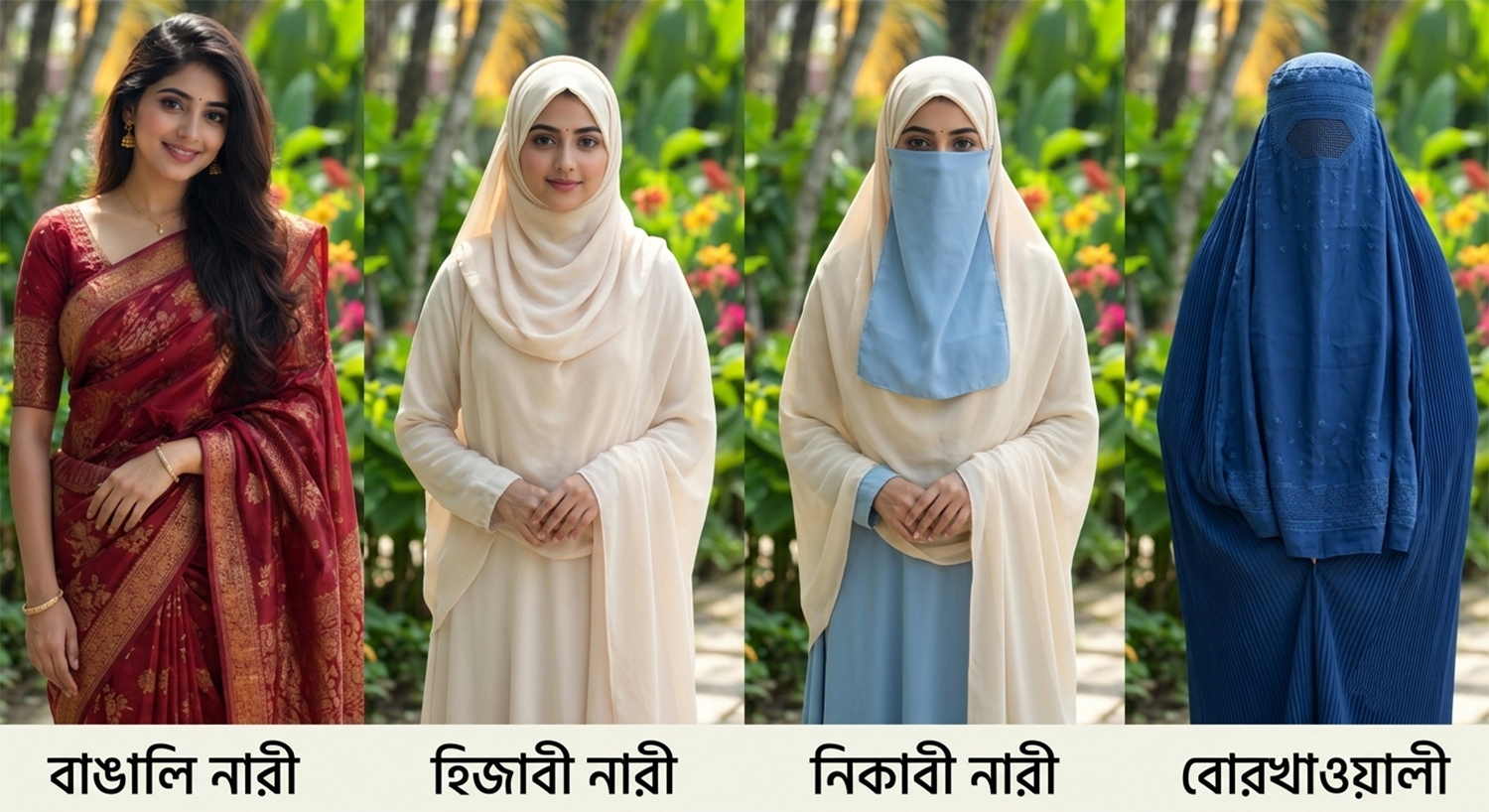
Hijab Niqab Burqa
Hijab, niqab and burqa: these restrictive garments for women offer no benefit except harm
Among the roughly 1.8 to 2 billion Muslims in the world, a significant portion of women wear hijab, niqab, or burqa. Although these garments are primarily part of a religious and cultural identity forcibly imposed on women, scientists have long been researching their physiological effects. How the degree of clothing coverage, environmental temperature, and humidity together affect the human body is now a well-established field of scientific research. Once, the thug and lecher Omar, by harassing Allah-Muhammad’s wives at night, had the verse of veiling downloaded—was that really beneficial for women?
Thermoregulation and sweating: Basic physiology
To maintain the human body temperature at 37°C, sweating and evaporation through the skin play the primary roles. In a 2014 study published in the Journal of Thermal Biology, it was found that in hot environments, the skin temperature of covered parts of the body is 2 to 4 degrees Celsius higher than that of uncovered parts.
When a full-body garment like the burqa covers the entire body, the process of sweat evaporation is hindered. As a result, heat cannot escape from the body and a “microclimate” is created, meaning that both temperature and humidity increase in the space between the clothing and the skin. Simply put, covering the head and neck can obstruct the body’s heat radiation process, which raises body temperature and causes discomfort, especially in hot environments. Researchers have observed that in sunlight, a headcover creates a paradoxical situation: on the one hand, it protects the head from direct solar heat; on the other hand, it prevents heat from dissipating from the head into the environment, thereby increasing the heat load.
Hot and humid climates: Southeast Asia and the Gulf region
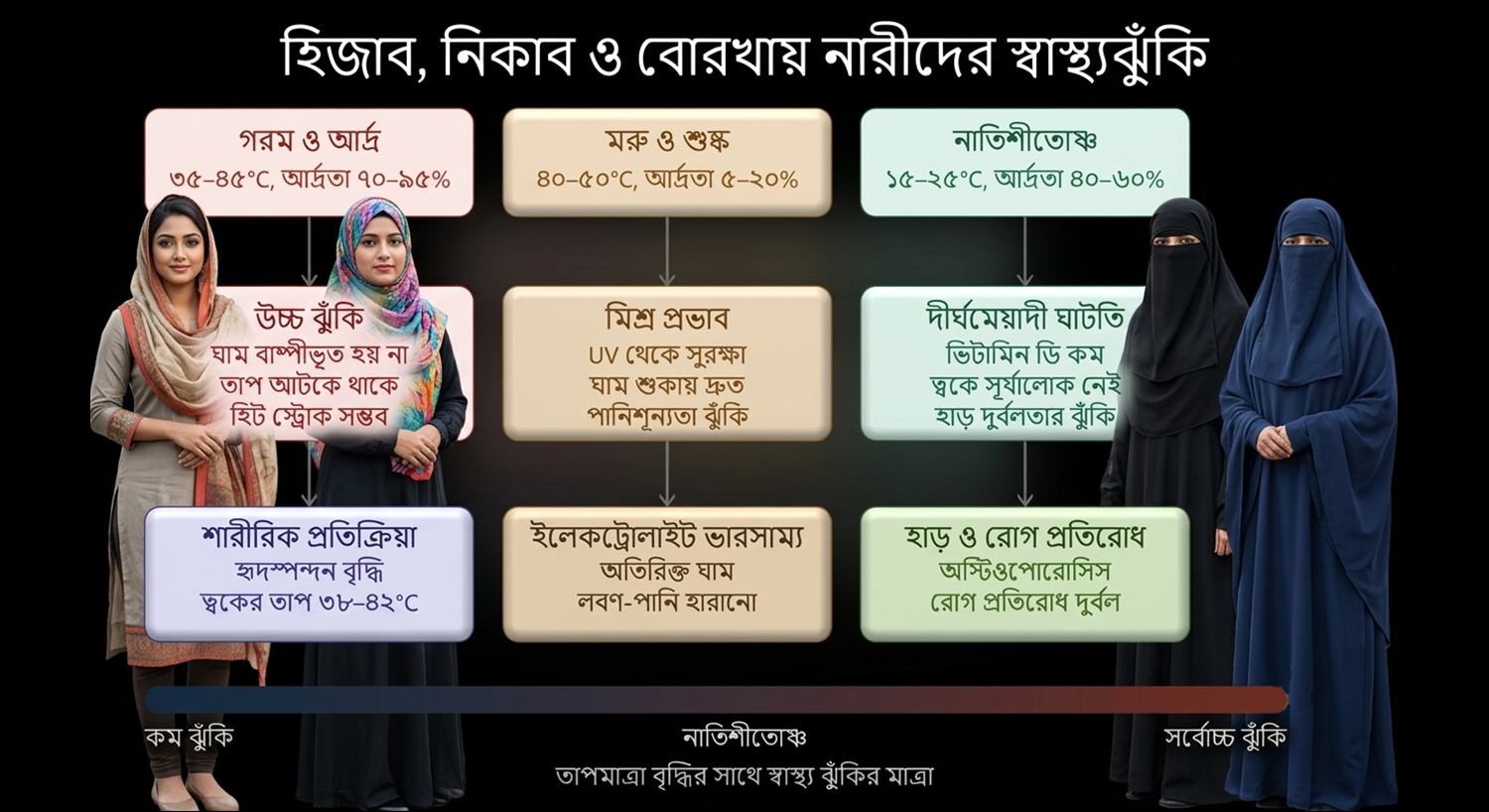
In Bangladesh, Malaysia, Indonesia, and the coastal areas of Saudi Arabia, temperatures reach 35–45°C and relative humidity can rise to 70–95%.
The research findings in this environment are alarming. In a survey conducted at the University of Malaya in Malaysia, the core body temperature of women wearing hijab and burqa was recorded to be about 0.5–1.0°C higher while working. Their heart rate was also on average 8 to 12 beats per minute higher, indicating cardiovascular stress.
In humid environments, sweat cannot evaporate, so the body sweats even more, increasing the risk of losing electrolytes (sodium, potassium, chloride). Spending long periods outside can lead to heat cramps, heat exhaustion, and in severe cases, heat stroke.
Dry and intense desert heat: Middle East and North Africa
The situation is different in the desert regions of Saudi Arabia, Kuwait, Egypt, and Algeria. Although temperatures reach 40–50°C, humidity remains only 5–20%, so sweat evaporates quickly. In this sense, dry heat may seem somewhat “tolerable,” but burqa and niqab create two new problems even here.
First, when sweat evaporates under the clothing, that moisture gets trapped, creating a localized humid environment and disrupting the normal cooling process of sweat. Second, in dry heat, people feel thirsty later, increasing the risk of dehydration. However, one positive aspect is that dark-colored clothing protects the skin from UV radiation and reduces the risk of skin cancer.
Temperate climates: Iraq, Europe, and North America
In Europe and North America, where there is less sunlight and winters are long, vitamin D deficiency has been identified as a specific health problem among women who wear hijab and niqab.
Multiple studies published in the journal Osteoporosis International have shown that the blood levels of vitamin D (25-hydroxyvitamin D) in Muslim women who wear hijab are on average 30–50% lower than in those who do not. When sunlight does not reach the skin, vitamin D synthesis does not occur, leading to reduced bone density and increased risk of osteoporosis, rickets (in children), and weakened immune function.
The NHS in the United Kingdom and health authorities in Australia recommend vitamin D supplements for women who wear hijab.
In a clinical study conducted in Basra, Iraq, vitamin D levels were compared between women wearing niqab and those wearing hijab. The study analyzed various vitamin D3-related parameters in 64 women who wore niqab and 60 women who wore hijab. When wearing hijab, only about 8% of the body’s skin is exposed to sunlight. This limited sunlight exposure significantly reduces vitamin D synthesis, which weakens calcium absorption in bones and the immune system.
Effects on mental health
Alongside physical effects, psychological research also presents a complex picture.
When heat-related discomfort persists for a long time, mental stress, irritability, and lack of concentration appear. A study in the journal Building and Environment found that high temperatures significantly reduce productivity and cognitive performance.
A recent study conducted on 409 people in the United Arab Emirates highlighted the mental effects of extreme heat. Among the participants, 86% reported heat-related fatigue and 43% reported heat stroke. Additionally, 45% suffered from anxiety and 36% from depression. Social isolation and loneliness were also observed in a significant number of people. These findings further increase the mental burden of going outside in full-body clothing.
On the other hand, many studies have found that women who voluntarily wear hijab experience higher self-esteem and identity stability. As Islam says—they are free women, they will be covered in jilbab, and those who go without clothes are enslaved sex-slaves. In other words, the psychological impact largely depends on the individual’s freedom of choice. Muslim women in this case suffer from a superiority complex syndrome.
The role of fabric in clothing
One thing is clear in all studies: the type of fabric plays a major role. Synthetic fabrics (polyester) trap more heat and moisture. Natural fabrics such as cotton, linen, and crepe facilitate air circulation. Light-colored and loose-fitting clothing absorbs less solar heat and allows airflow.
In 2024, an important study by researchers at Seoul National University was published in the journal Fashion and Textiles. Eight young female volunteers exercised under three conditions (without hijab, with rayon hijab, with polyester hijab) in hot humid (30°C, 70% humidity) and hot dry (36°C, 30% humidity) environments. It was found that in humid environments, average skin temperature and neck temperature were significantly higher with polyester hijab than with rayon hijab. The amount of sweating was also higher with polyester hijab compared to not wearing hijab.
The study found that wearing polyester hijab in warm environments causes more sweating than not wearing hijab. As sportswear, hijab can affect post-exercise hydration and body temperature regulation. However, one hopeful finding is that no study so far has identified exercising while wearing hijab as a serious safety risk.
Female repression in the name of Islamic clothing
The summary of scientific research is that the physical effects of hijab, niqab, and burqa vary widely depending on climate, fabric type, and duration of wear. In hot humid climates, heat-related health risks are highest; in dry desert climates, dehydration risk is primary; and in cold temperate countries, vitamin D deficiency is the most evident problem.
Science is not against culture or religion here; rather, it helps raise awareness to protect women’s health. Choosing appropriate clothing and fabric, drinking enough water, taking vitamin D supplements, and taking breaks from extreme heat can significantly reduce these risks.
Related Posts

Why does Allah show such preference for women with large breasts and large buttocks? Do men feel the same way? Does this give women any advantage?
If you leave Prophet Muhammad in Pattaya’s Walking Street and Beach Road after evening, inRead More
নারীর বড় বক্ষ ও নিতম্বের প্রতি আল্লাহর এতো পক্ষপাত কেন? পুরুষেরও কি তাই? এটা কি নারীকে সুবিধা দেয়?
আপনারা যদি পাতায়ার ওয়াকিং স্ট্রীটে ও বীচ রোডে সন্ধ্যার পর আলো আঁধারিতে নবী মুহাম্মদকে ছেড়েRead More

Do women like the color pink? What is the psychology behind it?
Last winter my friend Lamia went to buy a birthday present for her niece. TheRead More
Comments are Closed