
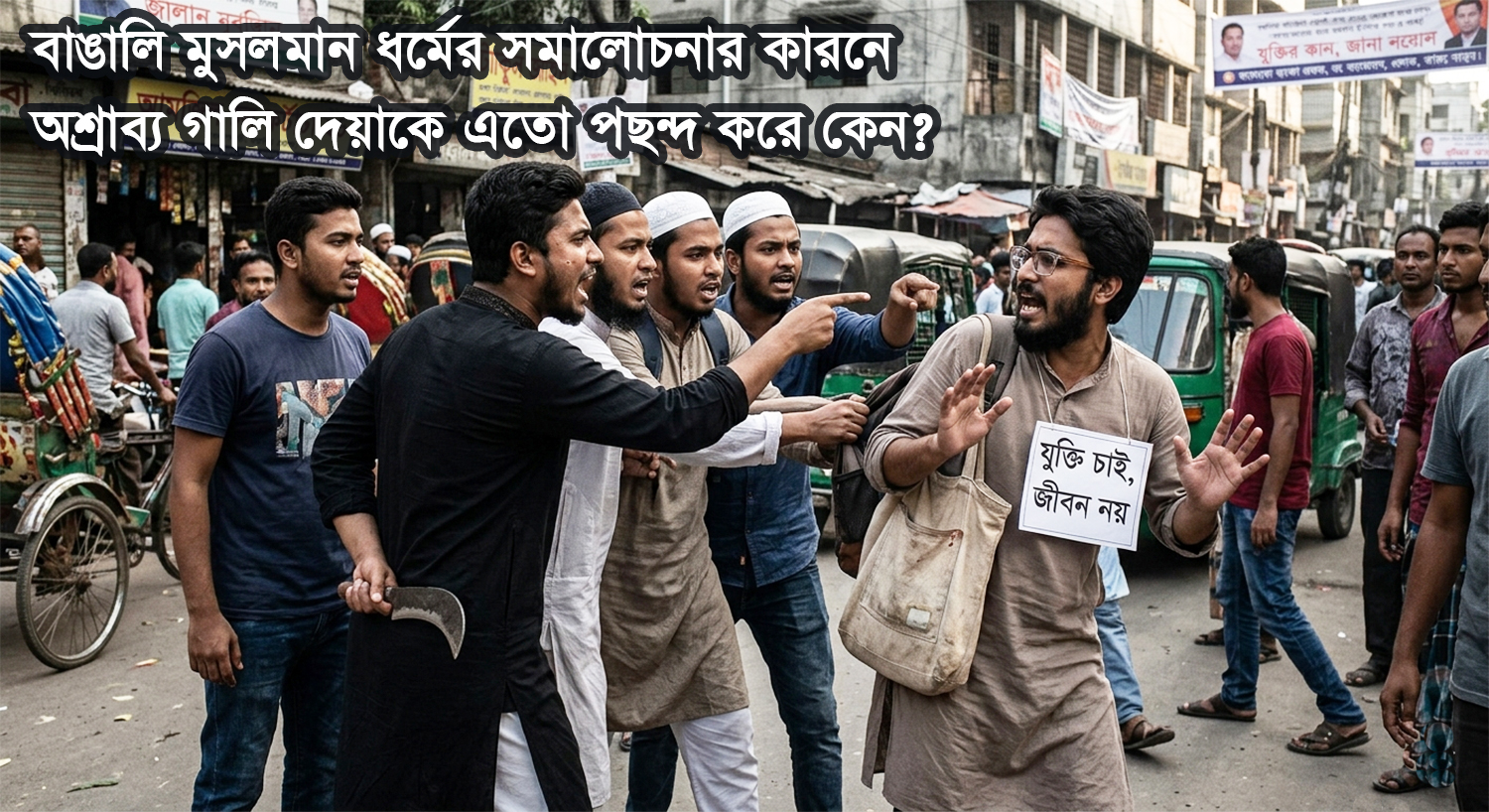
Bengali Muslims' Insult Culture!
Why do many Bangladeshi Muslims like using obscene insults when religion is criticized?
For the past few days I had been digging into a particular issue. Those of us who expose the dark sides of Islam in the Bengali language are constantly subjected to threats of murder, beating, and abuse directed at ourselves and our parents in obscene language. Among these, a common insult is calling someone a “bastard child,” and if the target is a woman, calling her a “whore.” A few days ago I saw a viral video where a Bangladeshi Muslim shopkeeper in New York hurled the same insults—“bastard, whore”—at a woman. Why do so many Bangladeshi Muslims treat this insult as so important? Did the Prophet of Islam, the Sahaba, or the founders of later madhhabs ever use such abusive language?
I browsed a few English-language social profiles of people who fiercely criticize Christianity, Buddhism, and Hinduism. I saw one person depict Jesus and Buddha sitting together in a bar having a conversation. There were about 2,000 comments. I checked to see if there were any abusive comments. To my surprise, no one used insults. Many people from different countries commented there, but no one went off-topic to call the author a “bastard child” or even used any ordinary swear word. Almost everyone presented their own opinions and arguments. Someone brought up Mahatma Gandhi, someone rejected the idea—but far from abusive language, no one even used mild rudeness toward one another.
Why this difference? Why do Bangladeshi Muslims who defend Islam have this culture of using insults? What is the psychological explanation? Why does this difference exist? To answer this question, we must simultaneously enter the history of Islamic jurisprudence, the research labs of social psychology, and the classrooms of Bangladesh’s education system.
The Islamic Roots of the Word “Bastard”
Walad al-Zina: A Legal Concept Turned Social Poison
The word “jarj” (bastard) in Bengali comes from “jarjat,” meaning an illegitimate child. In Islamic jurisprudence, its equivalent is walad al-zina (ولد الزنا) — the child of zina (illicit sexual relations).
In classical Islamic fiqh, the legal status of a walad al-zina is extremely harsh. The four Sunni madhhabs—Hanafi, Maliki, Shafi‘i, and Hanbali—agree that such a child will not inherit from the biological father and will not carry the father’s lineage (nasab). The child will be known only by the mother’s identity.
Doesn’t this feel inhumane? A child who had no hand in coming into this world is labeled “bastard” from birth, while the biological father—because he is a man—is protected by Islam!
The basis of this ruling is a hadith: “Al-waladu lil-firāsh wa lil-‘āhir al-ḥajar” — “The child belongs to the marriage bed, and the adulterer gets the stone.” (Sahih al-Bukhari, Hadith 2053).
However, there is an important nuance here. Scholars like Ibn Taymiyyah, Ibn al-Qayyim, and Hasan al-Basri held a different opinion: if the biological father acknowledges the child, then the child’s lineage should be established—because it protects the child’s interests. But this is a minority view. Mainstream Islam does not count it. A man can sleep with a woman, father a child, and then refuse responsibility, and Islam places the entire burden solely—and exclusively—on the woman. Thus, the insult “bastard child” also originates from Islam’s deeply rooted misogyny.
Did the Prophet or the Sahaba Use Abusive Language? Did They Tolerate Criticism?
In the early period of the Islamic state, there was a clear tendency to suppress dissent and intellectual opposition. Renaming Amr ibn Hisham—who was known as “Abu Hakam” (Father of Wisdom) in pre-Islamic Arabia—to “Abu Jahl” (Father of Ignorance) was not just ideological opposition; it was a political strategy to destroy the social standing of an opponent. The Prophet Muhammad sent assassins to kill his critics. The killings of poets like Ka‘b ibn al-Ashraf, Asma bint Marwan, and Abu Afak are seen by critics as acts of “silencing dissent” and “political assassination” in the modern sense. Poets at that time did not merely write poetry; they shaped public opinion. Killing them sent a message that the emerging state of Medina would silence any voice of propaganda against it. Additionally, a Sahabi once killed his slave woman for allegedly criticizing the Prophet; she was pregnant, and when he slit her belly, the fetus fell out. Even in such a brutal incident, the Prophet praised that Sahabi. The enforcement of death penalties for apostates and critics—without allowing room for repentance—is seen by critics as a severe violation of personal freedom, freedom of thought, and fundamental human rights.
However, alongside this, Islamic history also contains behaviors and events that appear contradictory to such extremism. During the Prophet Muhammad’s 13 years in Mecca and after the conquest of Mecca, he forgave many bitter enemies—something critics interpret as “strategic clemency” or political foresight. When the opposition was completely defeated and surrendered, sparing them instead of killing them en masse was a political move to integrate them into the new state and avoid bloodshed. Similarly, during the era of the Sahaba, rulers like Umar or Ali tolerated harsh criticism from ordinary people, mainly to maintain legitimacy and a reputation for justice within the Muslim community. From a critical perspective, these acts of leniency were not unconditional spiritual forgiveness but pragmatic decisions—where the state was weak or where forgiveness brought political advantage, leniency was shown; and where establishing authority required fear, critics and poets were suppressed with an iron hand.
Identity Fusion Theory and Religious Aggression
Identity Fusion: When “I” and “My Religion” Become One
In social psychology, the theory of Identity Fusion provides one of the most important answers to this question. According to research by William Swann and his colleagues, when a person’s personal identity and group identity become so fused that they cannot be separated, any attack on the group is felt as a personal attack.
Researchers have found that when identity fusion with religion (as opposed to nation) is high, support for retaliatory aggression increases significantly. This pattern holds even when religiosity and fundamentalism are controlled as variables.
In the context of Bangladesh, this means: for an average Bangladeshi Muslim, criticism of Islam is not just criticism of a religion—it is criticism of their own identity, their family, their ancestors, the core of their existence. This is why the reaction is not intellectual but visceral—felt in the gut—and often turns into insults like “your mother and father are this and that…”
Religious Commitment vs. Religious Involvement
Another important distinction found in research is between religious commitment and religious involvement.
Those who regularly attend places of worship and are actively involved in religious communities show lower levels of aggression—because they are familiar with the social, moral, and spiritual depth of religion.
But those who are committed to a religious identity but less active in religious practice show higher levels of anger and hostility when their religious identity feels threatened. This pattern is clearly visible in Bangladeshi social media—many who use abusive language know almost nothing about religious law, but the “Muslim” identity is the core of their existence. This includes the majority of moderate Muslims—who never read the Qur’an, Hadith, translations, or tafsir in Bengali, do not practice religion themselves, but when they see criticism of Islam, they act collectively as if ready to take someone’s life.
Cognitive Dissonance and Insults as a Substitute for Argument
According to the social psychology theory of Cognitive Dissonance, when a person experiences conflict between belief and logic and cannot resolve it through reasoning, they resort to other methods to protect the belief.
Insulting is one such alternative. When someone cannot refute an argument, they insult the arguer as a “bastard” or with other hateful words. This serves two purposes: first, it attempts to discredit the critic’s argument; second, it transforms the insulter’s internal discomfort into anger, which provides temporary relief.
Structural Factors in Bangladesh
Education System and Parallel Realities
Bangladesh has three parallel education systems: government Bengali-medium, English-medium, and madrasa education. These three systems teach different values, different histories, and different epistemologies.
Research by the Media Diversity Institute states: “Parallel and low-quality education and low media literacy have enabled the epidemic of hate speech on social media in Bangladesh.”
The same research notes: “People are consuming more information than before—but Facebook rumors leading to the burning of homes and temples show that most of us lack critical analysis and logical thinking skills.”
Blasphemy Laws and the Culture of Fear
Bangladesh was founded in 1971 as a secular state. In 1988, Islam was declared the state religion. Since then, a growing legal framework has emerged that suppresses religious criticism.
Section 28 of the Digital Security Act can criminalize any online content if it “hurts religious sentiment.” This vague language has effectively banned religious criticism.
When the state itself treats religious criticism as a crime, the message that reaches ordinary people is: a critic is an enemy, a criminal. In such an environment, insults are not just emotional reactions—they become socially sanctioned behavior.
Hefazat-e-Islam and Religious Polarization
The rise of Hefazat-e-Islam in 2013 dramatically changed Bangladesh’s religious climate. Among their 13 demands was the enactment of a blasphemy law with the death penalty. Bloggers were labeled “atheists” and “apostates,” and calls were made for their execution.
A generation raised in this political environment has learned: criticizing Islam is a crime worthy of death. In such a context, using insults may even seem like a mild reaction.
Comparative Analysis – Where Does the Difference Lie?
How Is Western Religious Criticism Different?
In English-speaking internet spaces where debates about Jesus and Buddha occur, the absence of abusive language has several reasons:
1. A long tradition of secularism: In the West, through the Renaissance, Enlightenment, and Reformation, a social contract emerged that confined religion to the realm of personal belief. In this environment, “criticizing religion” does not mean “attacking a person.”
2. Identity diversity: In Western societies, people have multilayered identities—profession, hobbies, nationality, political views. If one identity is attacked, they can stand on another. In Bangladesh, especially in lower-middle-class Muslim environments, the “Muslim” identity is often the only source of dignity.
3. Institutional culture of debate: In Western education systems, critical thinking and debate are taught directly. From childhood, children are allowed to ask “why?” In Bangladesh, especially in madrasas and government schools, rote-learning prevents the development of questioning ability.
4. Pluralistic experience: In a pluralistic society, people live with, talk to, and befriend those with different beliefs. This helps them move away from the mindset of “your religion is wrong, therefore you are my enemy.”
Why are Hindus and Buddhists comparatively less aggressive?
This is a generalization—there are exceptions, especially within Hindu nationalist (Hindutva) movements. But one comparative reason for lower aggression may be that Hinduism and Buddhism have long traditions of internal debate. In Hinduism, atheistic Charvaka philosophy and skeptical Nyaya philosophy existed within the mainstream. In Buddhist philosophy, questioning is encouraged.
Why is the insult “bastard” used so specifically?
This is the most relevant question, and the answer is multilayered.
Layer 1: A theological weapon
Since in Islamic fiqh, walad al-zina is a condemned category, calling someone a “bastard” carries a theological curse. The critic is not just being called wrong—they are being religiously stigmatized.
Layer 2: Patriarchal honor-structure
In South Asian patriarchal societies, family “izzat” (honor) is extremely important. This honor is built primarily on women’s sexuality. Calling someone a “bastard” means attacking the mother’s sexual character—which is the highest form of insult in a patriarchal society.
Thus this insult stands at the intersection of two power systems—religious and patriarchal.
Layer 3: Proxy attack
When the critic’s argument cannot be refuted, their family is attacked. This is a psychological defense mechanism—shifting attention from the content to the person’s identity.
Layer 4: Display of group solidarity
Publicly insulting someone online also serves another purpose: it sends a signal—“I am on your (Muslims’) side.” The insulter sometimes tries to present themselves as a defender of the religion in front of others.
Diaspora context – Why the same behavior in New York?
The example of the Bangladeshi Muslim shopkeeper in New York highlights the identity crisis of immigrants.
After migrating, many immigrants face a specific psychological pressure: they must rebuild their language, profession, and social status in a new culture. Amid this instability, religious identity becomes the only stable, reliable anchor.
Then any criticism of religion feels like an attack on the last refuge of their identity. The reaction therefore becomes disproportionate. And due to ingrained patriarchal mentality, attacking women verbally is seen by many as a sign of masculinity.
This pattern is not unique to Bangladeshi Muslims—similar behavior has been observed in various immigrant communities across different religions.
The cost of this culture
The cost for those who receive threats
In Bangladesh, multiple freethinkers including Avijit Roy and Rajib Haider have been murdered. Not just insults—there is a real chain from insult to threat, from threat to murder.
When asking questions becomes a life-risking act in a society, that society loses its capacity for knowledge production. And gradually this abusive, brainless generation keeps growing. We are seeing the evidence now. In the last 2–3 decades, their numbers, organizations, and aggression have increased significantly in Bangladesh.
The cost for Muslim society
This culture of abusive language is actually harming Muslim society itself. Because:
1. It shuts down dialogue, stopping genuine religious scholarship.
2. It creates a terrifying image of Islam to outsiders.
3. Muslim youth learn that arguments can be answered with insults—this blocks their intellectual development.
Dignity is what creates the difference
The absence of abusive language in English-language debates about Christianity, Buddhism, and Hinduism is not because those religions are “better.” The reason is that those societies have a long tradition of separating religious belief from personal identity—where saying “my religion may be wrong” does not mean “I am a failure as a human being.”
In Bangladeshi Muslim society, this separation (religion ≠ identity) has not yet occurred for most people. And until it does, the insult “bastard” will remain. Bangladeshi Muslims still do not understand that criticizing an ideology, its proponents, or its founders—even falsely—is part of fundamental free speech, recognized by most countries in the world.
The Muslim who uses insults is not protecting the Prophet—they are protecting their own fear and ignorance.
And understanding the difference between these two is the real work of education.
References & Bibliography
Psychology & Social Research:
- Swann, W. B. et al. (2009). “Identity Fusion: The Interplay of Personal and Social Identities in Extreme Group Behavior.” Journal of Personality and Social Psychology.
- Ozkan, M. et al. (2025). “Paths to peaceful and violent action: Identity fusion and group identification.” British Journal of Social Psychology.
- Wright, J. D. (2017). “Implications of Religious Identity Salience, Religious Involvement, and Religious Commitment on Aggression.” University of Western Ontario.
- Festinger, L. (1957). A Theory of Cognitive Dissonance. Stanford University Press.
Bangladesh-related Research:
- Media Diversity Institute (2021). “Bangladesh Sees Rise in Disinformation, Hate Speech and Violence Against Religious Minorities.”
- LSE South Asia Blog (2023). “Blasphemy Laws and Human Rights of Religious Minorities in Bangladesh.”
- Rashid, S. B. et al. (2025). “ALERT: A benchmark Bengali dataset for identifying and categorizing religiously aggressive texts.” Data in Brief.
- Tandfonline (2021). “‘Secularism’ or ‘no-secularism’? A complex case of Bangladesh.”
Islamic Jurisprudence:
- Sujimon, M. S. “Implications and Consequences of Illegitimate Child (Walad Al-Zina) in Islamic Law: A Classical View.”
- Legal Service India (2025). “Status of an Illegitimate Child in Islam.”
- Wikipedia: “Blasphemy law in Bangladesh.”
Related Posts
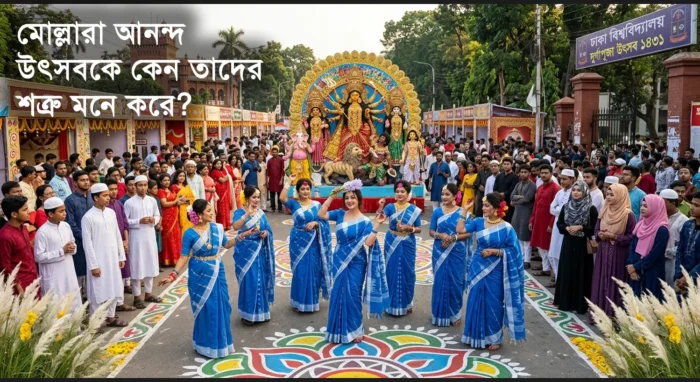
Why do Islamist clerics consider Bengali cultural festivals their enemy?
This year, unlike many previous years, the major Hindu religious festival Durga Puja in BangladeshRead More
ইসলামিস্ট মোল্লারা কেন বাঙালিদের আনন্দ উৎসবকে তাদের শত্রু মনে করে?
এবার বাংলাদেশে অন্যবারের তুলনায় বেশ শান্তিপূর্ণ, উৎসবমুখর পরিবেশে হিন্দু ধর্মের বড় ধর্মীয় উৎসব দূর্গাপূজা হয়েRead More
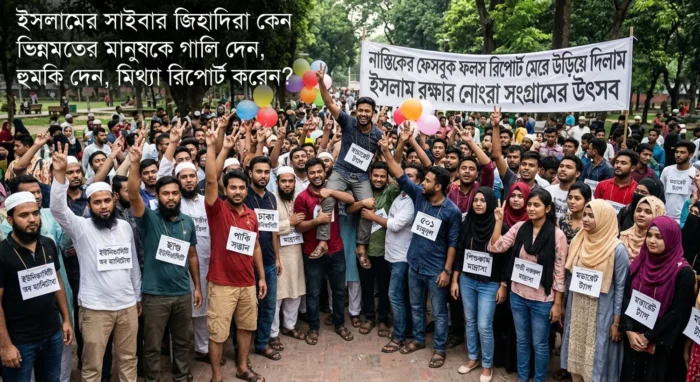
Why do Islamist cyber‑jihadis insult, threaten, and file false reports against people with different opinions?
Maulana Azhari once advised Islamists that sharing his Facebook posts is also an Islamic act;Read More
Comments are Closed